Smart HVAC Control: Lowering Your Electricity Bill Automatically in Singapore
Introduction: Why Smart HVAC Control Matters More Than Ever
Electricity bills in Singapore have a way of creeping up quietly—until one month, they don’t feel so quiet anymore. For most households, air conditioning is the biggest contributor. It runs for hours, often longer than we realise, especially in a climate where heat and humidity are constant.
This is where smart HVAC control starts to make a noticeable difference. Instead of relying on manual adjustments or fixed routines, smart systems adapt in real time. They learn your habits, respond to occupancy, and fine-tune cooling without you needing to think about it.
The appeal isn’t just convenience. It’s efficiency. When your cooling system only works as hard as it needs to, energy waste drops—and so does your electricity bill. Over time, that shift from reactive to automated control becomes more than a small upgrade. It becomes a smarter way to manage your home.
What Is Smart HVAC Control?
Understanding HVAC Systems in Modern Homes
HVAC stands for Heating, Ventilation, and Air Conditioning. In Singapore, the focus is almost entirely on the “AC” part, since cooling is essential year-round. Whether it’s a split-unit system in a condo or a centralized setup in a landed property, these systems are designed to maintain indoor comfort.
The challenge isn’t the system itself—it’s how it’s used. Most traditional setups rely on manual inputs. You turn it on, set a temperature, and leave it running. That works, but it’s rarely optimized.
What Makes HVAC “Smart”?
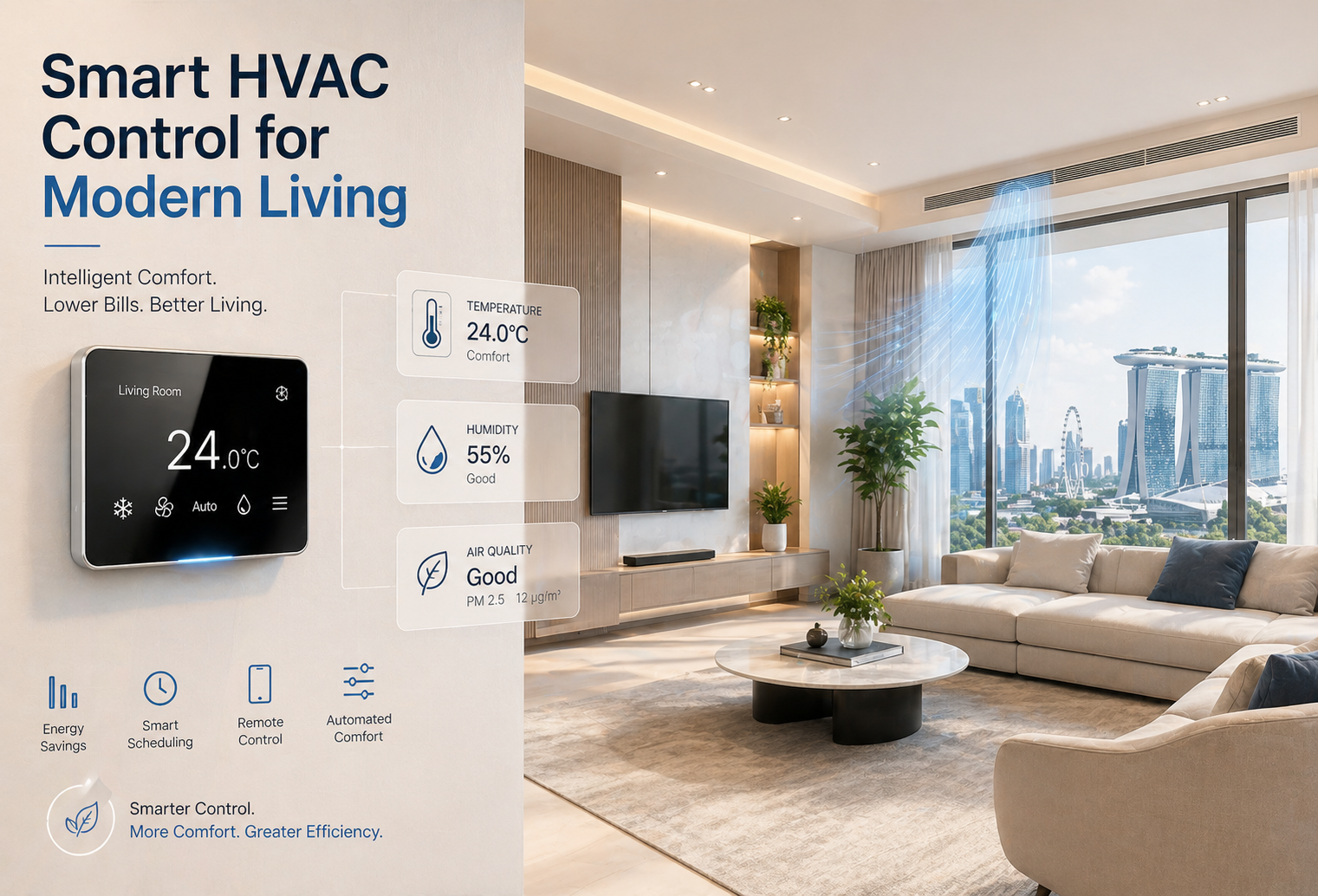
A smart HVAC Control system adds a layer of intelligence on top of your existing air conditioning. It connects to sensors, apps, and automation platforms to control how and when your system operates.
Instead of fixed settings, it adjusts dynamically. For example, it can reduce cooling when no one is in the room, or gradually adjust temperature based on time of day. Some systems even learn your daily patterns and pre-cool spaces before you arrive home.
How Smart HVAC Control Differs from Traditional Air Conditioning
The difference comes down to control and adaptability.
Traditional air conditioning:
- Runs based on static settings
- Requires manual adjustments
- Often leads to overcooling or energy waste
Smart HVAC control:
- Adjusts automatically in real time
- Responds to occupancy and environment
- Optimizes energy usage without compromising comfort
It’s less about replacing your air conditioner, and more about upgrading how intelligently it operates.
How Smart HVAC Control Works
Sensors, Automation, and Real-Time Adjustments
At the core of smart HVAC control are sensors. These can detect temperature, humidity, and even whether someone is in the room. That data feeds into the system, allowing it to make decisions instantly.
If a room is empty, the system can scale back cooling. If humidity rises, it can adjust airflow to maintain comfort without blasting cold air unnecessarily. These small adjustments, happening continuously, are what drive efficiency.
Integration with Smart Home Ecosystems
Smart HVAC systems don’t operate in isolation. They’re often part of a larger smart home setup. This means your air conditioning can work together with lighting, curtains, and other devices.
For instance, closing blinds during the hottest part of the day reduces heat gain, meaning your air conditioning doesn’t need to work as hard. These integrated automations create a more efficient overall environment.
Role of AI and Machine Learning in Climate Control
More advanced systems go a step further by using AI and machine learning. Over time, they analyze patterns—when you’re home, what temperatures you prefer, how quickly rooms cool down.
Instead of reacting, the system starts predicting. It might begin cooling your bedroom before you go to sleep or reduce usage during periods when you’re consistently away. This predictive layer is where smart HVAC control shifts from being convenient to genuinely cost-saving.
Key Benefits of Smart HVAC Control
Lower Electricity Bills Through Automation
The most immediate benefit is reduced energy consumption. By avoiding unnecessary cooling and optimizing runtime, smart HVAC control systems can significantly lower monthly electricity bills. It’s not about drastic changes. It’s about small, consistent improvements that add up over time.
Improved Indoor Comfort and Air Quality
Comfort isn’t just about temperature. It’s also about humidity and airflow. Smart systems maintain a more balanced indoor environment, which feels noticeably better than rooms that are simply “cold.” Some setups also integrate air quality monitoring, helping maintain healthier indoor air.
Energy Efficiency and Sustainability
With energy efficiency becoming a bigger priority in Singapore, smart HVAC aligns well with sustainability goals. Using less energy doesn’t just save money—it reduces your overall environmental impact. For homeowners who are conscious about energy use, this is a meaningful upgrade.
Remote Access and Convenience
Being able to control your air conditioning from your phone changes how you use it. You can turn it on before reaching home, adjust settings without getting up, or monitor usage remotely. It’s a small convenience, but one that quickly becomes part of your daily routine.
Why Smart HVAC Control Is Especially Relevant in Singapore
Climate Considerations: Hot and Humid Conditions
Singapore’s weather isn’t just warm—it’s consistently hot and humid. That combination makes air conditioning less of a luxury and more of a necessity.
The downside is that systems tend to run longer and harder, often leading to higher energy consumption. Without optimization, it’s easy to waste energy without realising it.
High Air Conditioning Usage in Urban Homes
In most HDB flats, condos, and landed homes, air conditioning is used daily. Bedrooms, living rooms, even home offices rely on it for comfort.
This high usage creates an opportunity. Even small efficiency improvements can lead to noticeable cost savings when applied consistently across multiple rooms.
Government Push for Energy Efficiency (Green Initiatives)
Singapore has been actively promoting energy-efficient living through various green initiatives. Smart home technologies, including HVAC automation, align with this direction.
Adopting smarter systems isn’t just about personal savings anymore—it’s part of a broader shift toward sustainable urban living.
Core Features to Look for in a Smart HVAC System
Smart Thermostats and Temperature Zoning
If there’s one feature that defines a smart HVAC Control system, it’s the thermostat—but not the basic kind most homes are used to. A smart thermostat doesn’t just control temperature; it manages how different areas of your home are cooled.
This is where zoning comes in. Instead of cooling the entire house uniformly, you can control temperatures room by room. Your bedroom can stay cool at night, while the living room doesn’t consume energy unnecessarily.
For homes in Singapore, where air conditioning is used heavily in specific zones rather than all spaces at once, this makes a big difference. It’s a simple concept, but one that directly impacts both comfort and energy usage.
Occupancy Detection and Motion Sensors
One of the most practical features—yet often overlooked—is occupancy detection. These sensors tell your system whether a room is actually being used.
It sounds basic, but think about how often air conditioning is left running in empty rooms. With motion sensors, the system can automatically reduce or pause cooling when no one is around, then resume when someone returns.
Over time, this alone can cut down a significant amount of wasted electricity without requiring any manual effort.
Scheduling and Automation Rules
Scheduling is where smart HVAC Control starts to feel truly “hands-off.” Instead of turning your air conditioning on and off daily, you set rules once and let the system handle the rest.
For example:
- Cooling your bedroom before bedtime
- Reducing usage during working hours when no one is home
- Adjusting temperature overnight to balance comfort and energy savings
The key is flexibility. Good systems allow you to fine-tune schedules rather than forcing rigid time blocks. This makes automation feel natural rather than restrictive.
Integration with Voice Assistants and Mobile Apps
Control matters, especially when it’s convenient. Most smart HVAC systems today connect to mobile apps, giving you full access wherever you are.
Beyond that, integration with voice assistants adds another layer of ease. A simple voice command can adjust temperature, switch modes, or turn the system on and off.
It’s not just about being “high-tech.” It’s about removing friction from everyday use, so you’re more likely to manage your system efficiently.
Smart HVAC Control vs Traditional Air Conditioning Systems
Cost Comparison (Short-Term vs Long-Term)
At first glance, traditional air conditioning seems cheaper. You install the unit, and that’s it. Smart HVAC systems, on the other hand, come with additional upfront costs—devices, sensors, and setup. But that’s only part of the picture.
Over time, energy savings begin to offset the initial investment. When your system runs more efficiently day after day, the reduction in electricity bills adds up. For many homeowners, the long-term cost ends up being lower with smart control in place.
Efficiency and Energy Consumption Differences
Traditional systems operate on a simple principle: run until manually stopped or until the set temperature is reached. There’s no awareness of occupancy, time of day, or usage patterns.
Smart HVAC Control flips that entirely. It adjusts continuously, making small decisions that prevent unnecessary energy use.
Instead of running at full capacity for hours, it fine-tunes output. That’s where the real efficiency comes from—not big changes, but consistent optimization.
User Experience and Control Capabilities
There’s also a noticeable difference in how you interact with the system.
Traditional setups rely on remote controls and manual input. Once set, they stay that way unless you intervene.
Smart systems feel more intuitive. You can control them remotely, automate routines, and let them adapt to your lifestyle. It’s less about managing your air conditioning, and more about letting it manage itself.
Real-World Use Cases of Smart HVAC Control
Residential Homes and Condominiums
In most Singapore homes, especially condos and HDB flats, usage patterns are quite predictable. People leave for work, return in the evening, and spend nights in bedrooms.
Smart HVAC systems take advantage of this. They reduce cooling during the day, then prepare the home before occupants return. It creates a comfortable environment without running the system unnecessarily for hours.
Landed Properties and Luxury Smart Homes
Larger homes come with a different challenge—scale. Cooling multiple rooms across different floors can be inefficient if everything runs simultaneously.
With smart zoning and automation, each area is controlled independently. Living spaces, bedrooms, and guest areas can all operate on separate schedules.
This level of control is especially valuable in luxury homes, where both comfort and efficiency are priorities.
Offices and Commercial Spaces
In offices, energy waste is even more common. Meeting rooms, workspaces, and shared areas are often cooled regardless of actual usage.
Smart HVAC systems can adjust based on occupancy and time, ensuring that energy is only used where needed. For businesses, this translates directly into cost savings without compromising employee comfort.
It’s a practical upgrade that improves both operations and expenses.
How Smart HVAC Reduces Electricity Bills Automatically
Intelligent Temperature Adjustments Based on Usage
One of the main reasons electricity bills drop with smart HVAC is simple: the system stops overcooling.
Instead of maintaining a fixed temperature all day, it adjusts based on real usage. If a room cools faster than expected, the system scales back. If conditions change, it adapts.
These micro-adjustments happen constantly, reducing unnecessary energy consumption without affecting comfort.
Avoiding Energy Waste When No One Is Home
Empty homes don’t need cooling—but traditional systems don’t always reflect that.
Smart HVAC systems detect when no one is around and automatically reduce or turn off cooling. When someone returns, they bring the temperature back to a comfortable level.
This eliminates one of the most common sources of energy waste: running air conditioning in unoccupied spaces.
Optimizing Cooling Cycles for Efficiency
Cooling isn’t just about reaching a temperature—it’s about how you get there.
Smart systems optimize cooling cycles to avoid spikes in energy usage. Instead of blasting cold air at full power, they gradually adjust output to maintain efficiency.
This smoother operation reduces strain on the system while lowering overall energy consumption. Over time, that translates into both cost savings and longer equipment lifespan.
Smart HVAC Integration with Smart Home Systems
Connecting HVAC with Lighting, Curtains, and Sensors
The real power of smart HVAC shows up when it’s connected to other smart home devices.
For example, automated curtains can close during peak sunlight hours, reducing heat entering the home. This means your air conditioning doesn’t have to work as hard.
Lighting and sensors can also play a role, triggering different cooling behaviors based on activity in the home.
Automation Scenarios (e.g., “Away Mode”, “Sleep Mode”)
“Away Mode” can turn off or reduce cooling when you leave the house. “Sleep Mode” can gradually adjust temperature throughout the night for better comfort and efficiency.
These scenarios remove the need for constant manual control. Once set, they run quietly in the background.
Compatibility with Popular Smart Home Platforms
A good smart HVAC system should integrate smoothly with broader smart home platforms. This ensures everything works together without friction.
Whether it’s app-based control or voice assistants, compatibility matters. It allows homeowners to manage their entire environment from a single interface, rather than juggling multiple systems.
That simplicity is often what determines whether people fully use smart features—or ignore them after installation.
Installation Process: What to Expect
Assessment of Existing HVAC System
Before anything gets installed, a proper assessment usually comes first. This step is more important than most people expect.
Not every air conditioning setup is immediately compatible with smart controls. A technician will typically evaluate your existing units, wiring, and layout to determine what can be integrated and what might need adjustment.
In many Singapore homes—especially condos and HDB units—the good news is that most split systems can be upgraded without major changes. It’s rarely a complete overhaul. More often, it’s about layering smart control on top of what you already have.
Retrofitting vs New Installations
If you already have an air conditioning system, retrofitting is the most common route. This involves adding smart controllers, sensors, and a central interface without replacing your existing units.
For new homes or major renovations, however, it’s worth designing the HVAC system with smart control in mind from the start. This allows for better zoning, cleaner integration, and fewer limitations.
The difference is subtle but important. Retrofitting works well, but a system designed for smart control from day one tends to feel more seamless.
Professional Setup vs DIY Options
There are DIY smart devices available, but HVAC control is one area where professional setup makes a noticeable difference.
A proper installation ensures:
- Accurate sensor placement
- Correct system calibration
- Reliable connectivity across devices
Without that, even a good system can underperform. For homeowners investing in smart HVAC for long-term savings, getting the setup right from the beginning is usually worth it.
Cost Breakdown of Smart HVAC Systems in Singapore
Initial Investment and Equipment Costs
Smart HVAC systems typically involve:
- Smart thermostats or controllers
- Sensors (temperature, motion, humidity)
- Integration hubs or platforms
Depending on the size of your home and level of automation, the upfront investment can vary quite a bit. A basic setup for a smaller condo unit might be relatively affordable, while a fully integrated system for a landed property will naturally cost more. What matters is not just the price, but how it aligns with your usage and goals.
Installation and Setup Fees
Installation costs depend on complexity. A straightforward retrofit is usually quicker and less expensive, while more advanced setups—especially those involving multiple zones or integrations—require more time and planning.
In Singapore, professional smart home providers typically handle both installation and configuration, ensuring everything works as intended from day one.
It’s also worth noting that a well-installed system tends to perform better, which directly impacts the savings you’ll see later.
Long-Term Savings and ROI Analysis
This is where smart HVAC starts to make financial sense.
Instead of looking only at upfront cost, consider the monthly reduction in electricity bills. Even moderate savings, when applied consistently, add up over time.
For households that use air conditioning daily, the return on investment can be surprisingly reasonable. It’s not an overnight payoff—but over a few years, the system often pays for itself while continuing to generate savings beyond that.
Common Mistakes to Avoid When Implementing Smart HVAC
Over-Automation Without Understanding Usage Patterns
One of the biggest mistakes is trying to automate everything immediately.
It’s tempting to set up multiple rules, schedules, and scenarios all at once. But without understanding your actual daily patterns, this can lead to inefficient setups that feel restrictive rather than helpful.
A better approach is to start simple, observe how your home is used, and refine automation over time.
Choosing Incompatible Devices
Not all smart devices work well together. Mixing different brands or systems without checking compatibility can create frustration later on. You might also checking on the best smart home brands in Singapore 2026.
Disconnected systems mean limited automation, unreliable performance, and more manual intervention—exactly what smart HVAC is supposed to reduce.
Working with a unified ecosystem or a knowledgeable provider helps avoid this issue entirely.
Ignoring Proper System Calibration
Even the best system won’t perform well if it isn’t calibrated properly.
Sensor placement, temperature accuracy, and airflow adjustments all play a role. If these aren’t set up correctly, you might end up with uneven cooling or inaccurate readings.
It’s one of those details that’s easy to overlook, but it directly affects both comfort and energy efficiency.
Expert Tips to Maximize Energy Savings
Setting Optimal Temperature Ranges
Many people assume colder is always better, but that’s not the case.
In Singapore, setting your air conditioning between 24°C and 26°C often strikes the best balance between comfort and energy efficiency. Going lower increases energy consumption significantly without providing much additional comfort.
Small adjustments here can have a bigger impact than expected.
Using Scheduling and Automation Effectively
Automation works best when it aligns with your routine.
Instead of running your system continuously, set schedules that reflect when you’re actually at home. Combine this with occupancy sensors to fine-tune usage even further.
The goal isn’t to restrict comfort—it’s to eliminate unnecessary runtime.
Regular Maintenance and System Updates
Efficiency isn’t just about smart features. It also depends on how well your system is maintained.
Cleaning filters, checking airflow, and ensuring software updates are applied all contribute to consistent performance. A well-maintained system doesn’t need to work as hard, which translates into lower energy usage.
It’s a simple habit, but one that supports everything else.
Advanced Strategies for Smart HVAC Optimization
Leveraging Data Insights and Usage Analytics
One of the advantages of smart HVAC systems is access to data. Over time, you can see how and when energy is being used.
This insight allows you to identify patterns—like peak usage times or areas where energy might be wasted. From there, you can adjust settings to improve efficiency even further. It turns your HVAC system from a passive utility into something you can actively optimize.
Custom Automation Based on Lifestyle Patterns
Every household is different. A family with kids will have different usage patterns compared to someone living alone.
Advanced setups allow for highly customized automation. For example, cooling specific rooms at certain times, or adjusting settings based on weekend vs weekday routines. These tailored automations are where smart HVAC truly becomes “personalized.”
Integrating Renewable Energy Sources
For homeowners looking to go a step further, integrating HVAC systems with renewable energy—like solar panels—can amplify savings.
When your cooling system is partially powered by renewable energy, your reliance on the grid decreases. Combined with smart optimization, this creates a more efficient and sustainable setup overall.
It’s not necessary for everyone, but for those exploring long-term energy strategies, it’s worth considering.
Security and Privacy Considerations
Protecting Your Smart Home Network
Once your HVAC system is connected to the internet, it becomes part of your broader home network. That’s not a problem—but it does mean basic security matters more than before.
Start with the fundamentals. Use a strong Wi-Fi password, avoid default credentials, and ensure your router firmware is up to date. These small steps go a long way in preventing unauthorized access.
A smart HVAC system is only as secure as the network it runs on. Treat it the same way you would any connected device in your home.
Data Privacy in Connected HVAC Systems
Smart systems collect data to function effectively—temperature preferences, occupancy patterns, usage schedules. This data is what allows the system to optimize performance.
The key is understanding how that data is used. Reputable providers are transparent about data handling and prioritize user privacy. It’s worth taking a moment to review privacy policies, especially if the system relies on cloud-based services. In most cases, the data isn’t invasive—but being informed helps you stay in control.
Best Practices for Safe Usage
Keep your apps updated, avoid connecting to unsecured networks when accessing your system remotely, and review device permissions occasionally. If multiple people in your household have access, ensure permissions are set appropriately.
None of this is complicated, but it’s often overlooked. A few simple habits keep your smart HVAC system both efficient and secure.
Future Trends in Smart HVAC and Smart Homes
AI-Driven Predictive Climate Control
Smart HVAC is already adaptive, but the next step is predictive.
Future systems won’t just respond to your habits—they’ll anticipate them with greater accuracy. Based on historical data, weather forecasts, and even calendar integrations, your home could prepare itself before you even think about it.
It’s a subtle shift, but one that makes automation feel almost invisible.
Integration with Smart Grids and Energy Providers
As cities move toward smarter infrastructure, HVAC systems are expected to integrate more closely with energy providers.
This could mean adjusting usage during peak demand periods or optimizing energy consumption based on real-time electricity pricing. For homeowners, it translates into additional savings without needing to actively manage anything.
In a place like Singapore, where urban efficiency is a priority, this kind of integration feels like a natural progression.
Sustainability and Green Building Innovations
Sustainability isn’t just a trend—it’s becoming a standard.
Smart HVAC systems are increasingly designed to align with green building practices, focusing on reducing energy waste and improving overall efficiency. From better insulation integration to smarter airflow management, the ecosystem around HVAC is evolving.
For homeowners, this means future systems won’t just be smarter—they’ll be more aligned with long-term environmental goals as well.
Choosing the Right Smart HVAC Provider in Singapore
What to Look for in a Smart Home Company
Not all smart home providers deliver the same level of quality. Some focus on hardware, others on software, but the best ones understand how everything works together.
Look for a provider that offers:
- End-to-end solutions (from consultation to installation)
- Strong after-sales support
- Proven experience with similar home types
The goal isn’t just to install a system—it’s to ensure it actually performs well in your daily life.
Importance of Local Expertise and Support
Singapore’s housing landscape is unique. HDB layouts, condo configurations, and landed properties all come with different requirements.
A provider with local experience understands these nuances. They know what works, what doesn’t, and how to optimize systems for the local climate.
This kind of practical knowledge often makes a bigger difference than the technology itself.
Why LivingArt Stands Out
When it comes to smart HVAC control in Singapore, working with a specialized provider like LivingArt Singapore brings a level of confidence that DIY solutions often can’t match.
Their approach typically goes beyond just installing devices. It involves understanding how your home is used, then designing a system that fits naturally into your lifestyle.
That difference shows up in the details—better automation, smoother integration, and systems that actually deliver on energy savings.
Is Smart HVAC Control Worth It?
Who Should Consider Upgrading
If you rely on air conditioning daily—and most households in Singapore do—smart HVAC control is worth considering.
It’s especially relevant for:
- Families with consistent daily routines
- Homeowners looking to reduce electricity bills
- Anyone investing in a broader smart home setup
In these cases, the benefits tend to be clear and measurable.
Situations Where It May Not Be Necessary
That said, it’s not always essential.
If your air conditioning usage is minimal or highly irregular, the cost of upgrading may not justify the savings. Similarly, smaller spaces with limited usage might not see a significant difference.
The value of smart HVAC comes from consistent use. Without that, the impact is naturally reduced.
Final Cost vs Benefit Evaluation
Ultimately, it comes down to balance.
Smart HVAC control requires an upfront investment, but it delivers ongoing savings, improved comfort, and better overall efficiency. For many homeowners, especially in Singapore’s climate, that trade-off makes sense.
It’s not just about spending less—it’s about using energy more intelligently.
Summary: Smarter Cooling, Lower Bills
Smart HVAC control changes the way we think about air conditioning. Instead of a system that simply runs when switched on, it becomes something responsive, adaptive, and efficient.
By automating temperature control, reducing unnecessary usage, and integrating with your daily routine, it helps lower electricity bills without sacrificing comfort.
In a climate where cooling is essential, this shift isn’t just convenient—it’s practical. Over time, the combination of savings, comfort, and control makes smart HVAC less of a luxury and more of a smart, long-term decision.
FAQ: Smart HVAC Control in Singapore
1. How much electricity can I save with smart HVAC control?
Savings vary depending on usage, but many households see noticeable reductions due to better energy management and reduced waste.
2. Can I install smart HVAC in an existing air conditioning system?
Yes, most systems in Singapore can be retrofitted with smart controllers without needing full replacement.
3. What is the best temperature setting to save energy in Singapore?
Typically between 24°C and 26°C for a balance between comfort and efficiency.
4. Do smart HVAC systems require constant internet connection?
An internet connection is needed for remote control and automation features, but basic functions may still work offline.
5. Is smart HVAC suitable for HDB flats and condos?
Yes, it works well for both and can be tailored to different layouts and usage patterns.
6. How long does installation typically take?
Most installations can be completed within a day, depending on system complexity.
7. Are there maintenance requirements for smart HVAC systems?
Regular aircon maintenance still applies, along with occasional software updates for the smart components.
8. Is smart HVAC compatible with voice assistants like Alexa or Google Home?
Most modern systems support integration with popular voice assistants for easier control.