The Future of Smart Home in Singapore: 2030 Smart Home System, Trend, Technologies, and What Should Expect
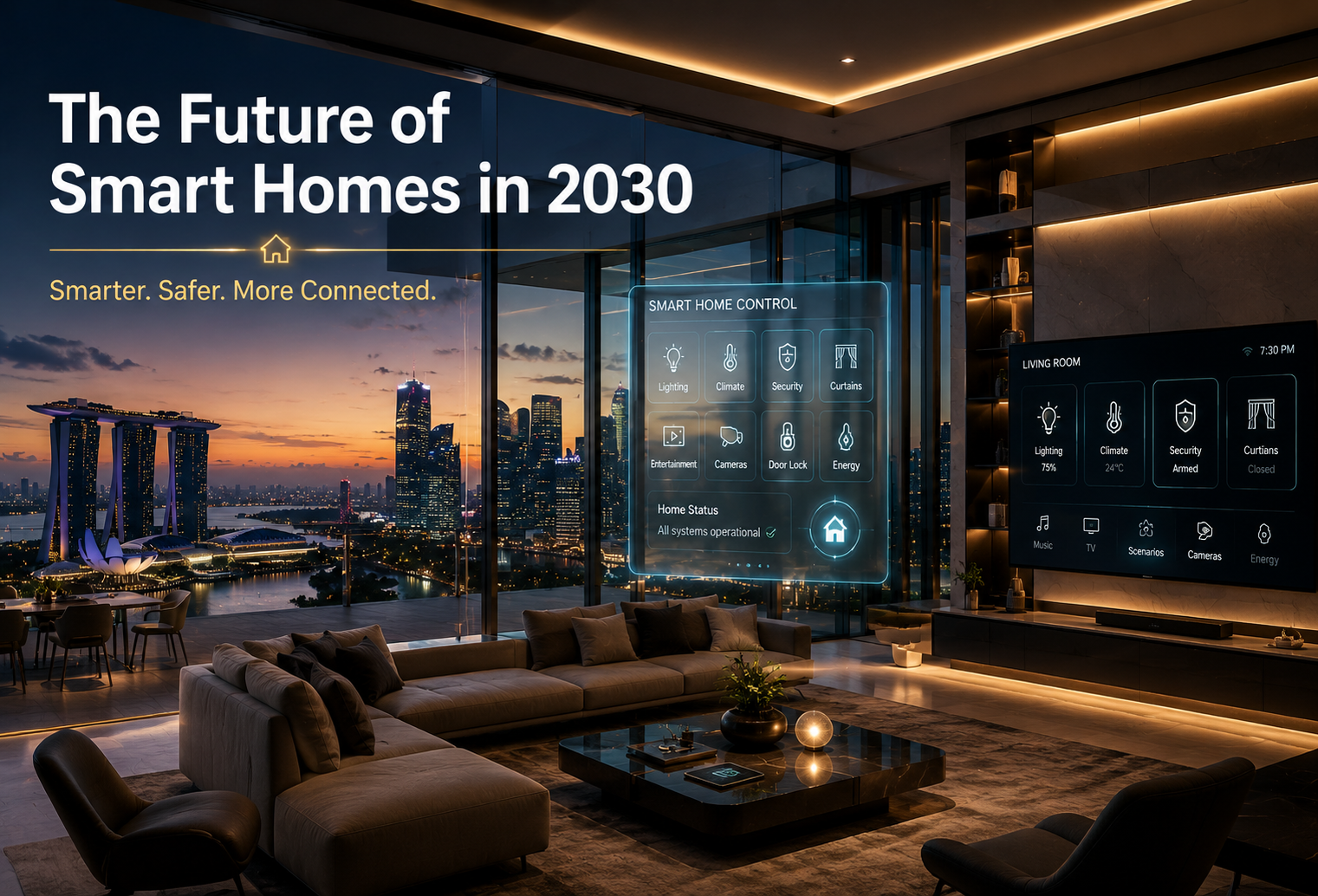
Introduction: Why Smart Homes Singapore Are Evolving Faster Than Ever
Not long ago, the idea of controlling your lights, air conditioning, or security system from a smartphone felt futuristic. Today, it’s becoming a standard feature in many modern homes. What was once considered a luxury is now increasingly viewed as a practical way to improve convenience, security, and energy efficiency.
The smart home industry including smart home Singapore has grown rapidly over the past decade, driven by advances in artificial intelligence, Internet of Things (IoT) technology, faster connectivity, and changing consumer expectations. Homeowners are no longer looking for isolated smart gadgets. Instead, they want connected ecosystems that work seamlessly together, making daily life simpler and more intuitive.
As we move toward 2030, the conversation around smart homes is shifting again. The focus is no longer just on remote control or automation. The next generation of smart home Singapore technology is expected to be more intelligent, predictive, and personalized. Rather than waiting for users to give commands, future smart homes will learn routines, anticipate needs, and make real-time adjustments based on behaviour, preferences, and environmental conditions.
This evolution is particularly relevant in urban environments such as Singapore, where space efficiency, sustainability, and connected living continue to shape residential developments. From smart lighting and climate control to AI-powered security and wellness-focused automation, homeowners are increasingly seeking solutions that enhance both comfort and long-term property value.
At the same time, emerging technologies such as Matter compatibility, edge computing, and advanced voice assistants are helping solve many of the challenges that previously limited smart home adoption. Devices from different manufacturers can now work together more effectively, creating a more unified and reliable experience for users.
The future of smart homes in 2030 is not about adding more devices for the sake of technology. It’s about creating living environments that are smarter, safer, more energy-efficient, and better aligned with the way people actually live.
In this guide, we’ll explore the most important smart home trends shaping the next decade, the technologies expected to transform modern living, and what homeowners should consider today to prepare for the connected homes of tomorrow.
What Is a Smart Home System? A Beginner’s Guide
At its core, a smart home Singapore is a residence equipped with connected devices that can be monitored, controlled, or automated through a central system. Read Smart Home Solution 101 to know more about it deeply before we go thru trend in 2030. These devices may include lighting, air conditioning, security cameras, smart locks, curtains, entertainment systems, and household appliances.
The real value of a smart home isn’t the individual devices themselves. It’s how they work together. For example, a single command can smart switch off all lights, lock the doors, lower the blinds, and activate security monitoring before you leave home.
Modern smart homes rely on technologies such as Wi-Fi, Bluetooth, Zigbee, Z-Wave, and Matter to enable communication between devices. As technology continues to evolve, these systems are becoming easier to manage and significantly more reliable than early-generation solutions.
Smart Home Singapore Market Outlook: What to Expect by 2030
The global smart home market is expected to expand significantly over the next few years as consumers prioritize convenience, energy efficiency, and home security.
Several factors are accelerating adoption:
- Rising energy costs
- Growth of AI-powered home automation
- Increased remote and hybrid work lifestyles
- Greater awareness of home security
- Smart city initiatives worldwide
In Singapore, smart home adoption is expected to grow alongside new residential developments and government-led digital transformation initiatives. Homeowners are increasingly viewing smart home technology as a long-term investment rather than a luxury upgrade.
Trend #1: AI-Powered Smart Homes Solutions Become the New Standard
Artificial intelligence is set to become the backbone of future smart homes.
Today’s automation typically follows predefined rules. For example, lights turn on at a scheduled time or air conditioning activates when a temperature threshold is reached. By 2030, AI will make these systems far more adaptive.
Smart homes will learn household routines, identify behavioural patterns, and make proactive adjustments without requiring constant user input. Your home may automatically optimize cooling based on weather forecasts, adjust lighting based on occupancy, or suggest energy-saving actions based on usage patterns.
The result is a home environment that feels less like a collection of devices and more like an intelligent assistant working quietly in the background.
Trend #2: Fully Integrated Smart Home Ecosystems including Smart Home Apps
One of the biggest frustrations homeowners face today is managing multiple apps for different devices. This problem is gradually disappearing.
The future belongs to unified smart home Singapore ecosystems where lighting, security, entertainment, climate control, and appliances operate within a single platform.
The emergence of Matter compatibility is playing a major role in this shift. Instead of worrying whether devices from different brands can communicate, homeowners can expect greater interoperability and easier integration.
For users, this means a smoother experience, simpler setup, and fewer technology headaches.
Trend #3: Voice Control and Natural Language Control Evolution Smart Device
Voice control has already become a familiar feature in many homes such as Alexa and Siri now, but its capabilities are expected to advance dramatically by 2030. You can read more about Voice Assistant Integration 2026.
Future voice assistants and voice command will move beyond simple commands such as “turn on the lights.” They will understand context, intent, and natural conversations.
Instead of issuing multiple instructions, homeowners may simply say, “I’m heading to bed,” and the home will automatically activate a personalized nighttime routine. This could include adjusting lighting, locking doors, setting the temperature, and turning off entertainment systems.
As AI improves, voice interaction will become more natural, making smart home technology accessible to users of all ages.
Trend #4: Energy-Efficient and Sustainable Smart Homes
Sustainability will be a major driver of smart home Singapore adoption by 2030. Smart lighting, intelligent climate control, and energy monitoring systems will help homeowners reduce unnecessary consumption without sacrificing comfort.
Instead of manually managing utilities, homes will automatically optimize energy usage based on occupancy, weather conditions, and electricity pricing. For environmentally conscious homeowners, this creates both cost savings and a smaller carbon footprint.
Trend #5: Advanced Smart Home Security and Surveillance Smart Home Device
Home security is evolving from simple monitoring to intelligent protection.
AI-powered cameras can already distinguish between people, pets, vehicles, and unusual activity. By 2030, security systems are expected to become even more proactive, detecting potential threats before incidents occur.
Combined with smart locks, biometric authentication, and real-time alerts, homeowners will have greater visibility and control over their property regardless of location.
Trend #6: Smart Health and Wellness Technologies
The next generation of smart home Singapore will focus not only on convenience but also on wellbeing.
Air quality sensors, sleep optimization systems, circadian lighting, and health-monitoring devices are becoming increasingly common. These technologies help create healthier indoor environments while supporting better sleep, productivity, and overall quality of life.
This trend is particularly relevant as more people spend significant time working from home.
Trend #7: The Rise of Autonomous Home Management
Future smart homes will require less manual intervention.
Routine tasks such as appliance maintenance, energy management, cleaning schedules, and inventory tracking may become largely automated. Homes will be able to identify potential issues before breakdowns occur, helping homeowners avoid costly repairs and disruptions.
Trend #8: Smart Entertainment Experiences
Entertainment systems are becoming more immersive and interconnected.
By 2030, homeowners can expect seamless integration between audio, video, gaming, and smart home controls. Personalized entertainment settings may automatically adjust lighting, sound, and screen preferences based on individual users and activities.
Trend #9: Smart Home Singapore Connectivity Beyond Wi-Fi
Reliable connectivity remains essential for any smart home Singapore ecosystem.
Emerging technologies such as 5G, edge computing, and next-generation IoT networks will enable faster response times and greater reliability. This will support more connected devices while reducing latency and improving overall system performance.
Trend #10: Smart Homes and Smart Cities Integration
As cities become smarter, homes will become part of a larger connected infrastructure.
Future smart homes may communicate with energy grids, transportation networks, and public services. This integration could improve energy efficiency, traffic management, and sustainability efforts across entire communities.
The Benefits of Smart Homes in 2030
The appeal of smart home Singapore technology extends beyond convenience.
Key benefits include:
- Improved energy efficiency
- Enhanced security and safety
- Greater comfort and personalization
- Better health and wellness support
- Increased property value
- Reduced day-to-day management effort
As technology matures, these advantages are likely to become even more accessible to average homeowners.
Challenges and Limitations of Future Smart Homes
Despite the benefits, smart homes Singapore are not without challenges.
Privacy concerns remain a common consideration as more devices collect and process data. Cybersecurity will continue to play an important role, particularly as homes become increasingly connected.
Cost can also be a barrier, especially for large-scale installations. However, ongoing technological advancements are expected to make smart home Singapore solutions more affordable over time.
Smart Home Singapore Technologies: What to Invest In Today for 2030 Readiness
Homeowners don’t need to wait until 2030 to start preparing.
The most future-ready investments today include smart lighting, climate control systems, smart security solutions, automated curtains, and centralized control platforms. Choosing scalable systems that support interoperability can help avoid expensive upgrades later.
Smart Home vs Traditional Home: A 2030 Comparison
Compared to traditional homes, smart homes Singapore offer greater efficiency, convenience, and adaptability.
While conventional homes rely heavily on manual operation, smart homes can automate repetitive tasks, optimize resource consumption, and provide real-time insights into household activities.
Over the long term, these advantages often translate into improved user experience and better operational efficiency.
Smart Home vs DIY Automation: Which Is Better?
DIY smart home products can be suitable for basic automation needs. However, as systems become more complex, professional installation often provides a more reliable and seamless experience.
Professionally designed smart homes Singapore typically offer better integration, centralized control, long-term scalability, and ongoing technical support.
For homeowners seeking a fully connected ecosystem, expert planning often delivers better results than piecing together multiple standalone solutions.
Common Smart Home Mistakes to Avoid
Many homeowners focus on purchasing devices before developing a clear strategy.
Common mistakes include:
- Choosing incompatible products
- Overlooking network infrastructure
- Ignoring cybersecurity measures
- Prioritizing gadgets over practical needs
- Failing to plan for future expansion
A well-designed smart home Singapore should solve real problems rather than add unnecessary complexity.
Expert Tips for Building a Future-Proof Smart Home
The most successful smart home Singapore projects start with a long-term mindset.
Prioritize interoperability, invest in reliable connectivity, and focus on automation that improves everyday living. Selecting an experienced smart home provider can also help ensure systems remain scalable as technology evolves.
How to Prepare Your Home for Smart Living in 2030
Preparing for the future doesn’t require a complete renovation.
Start by identifying areas where automation can deliver immediate value, such as lighting, security, climate control, or energy management. From there, build a roadmap that allows gradual expansion over time.
This approach helps maximize return on investment while maintaining flexibility.
Why Professional Smart Home Design Matters
A professionally designed smart home considers far more than device selection.
System architecture, network planning, user experience, security, and future scalability all play important roles. Proper design ensures technologies work together seamlessly while minimizing technical issues down the road.
For many homeowners, professional guidance can significantly reduce the risks associated with long-term smart home investments.
EEAT: Insights From Smart Home Industry Professionals
Experienced smart home integrators consistently see the same pattern: homeowners achieve the best outcomes when technology is aligned with lifestyle needs.
Rather than focusing on trends alone, successful projects prioritize usability, reliability, and future flexibility. This practical approach often delivers greater satisfaction than simply installing the latest gadgets.
As smart home Singapore technology continues to evolve, expert planning remains one of the most valuable investments homeowners can make.
Conclusion: The Smart Home of 2030 Is Closer Than You Think
The future of smart homes Singapore is no longer a distant concept. Many of the technologies expected to define 2030 are already available today in various forms.
Artificial intelligence, integrated ecosystems, energy-efficient automation, advanced security, and wellness-focused solutions are reshaping how people interact with their homes.
For homeowners in Singapore, the opportunity lies in making informed decisions today that support a smarter, more connected future tomorrow.
Frequently Asked Questions (FAQ)
What will smart homes look like in 2030?
Smart homes in 2030 are expected to be more intelligent, automated, and personalized, using AI to anticipate homeowner needs and optimize daily living.
Will AI control most smart home functions by 2030?
AI is likely to play a significant role in automation, helping manage energy usage, security, comfort, and household routines with minimal user input.
Are smart homes worth investing in today?
For many homeowners, smart home Singapore technology can improve convenience, security, energy efficiency, and long-term property value.
How secure will smart homes be in the future?
Future systems are expected to include stronger cybersecurity measures, biometric authentication, and AI-powered threat detection capabilities.
What smart home technologies should I install first?
Smart lighting, security systems, climate control, and centralized automation platforms are often considered the best starting points.
How much does a smart home cost in Singapore?
Costs vary depending on property size, system complexity, and selected technologies. Basic solutions can start relatively affordably, while full-home automation requires a larger investment.
Can existing homes be upgraded into smart homes?
Yes. Most existing properties can be retrofitted with smart home devices and automation systems without major structural changes.
What should I look for in a smart home provider?
Look for experience, strong technical support, scalable solutions, and systems that support future compatibility and integration.