
KNX Singapore vs Legrand and Lutron: Which Smart Home System Is Right for Your Home?
Why More Singapore Homeowners Are Choosing Smart Home Automation
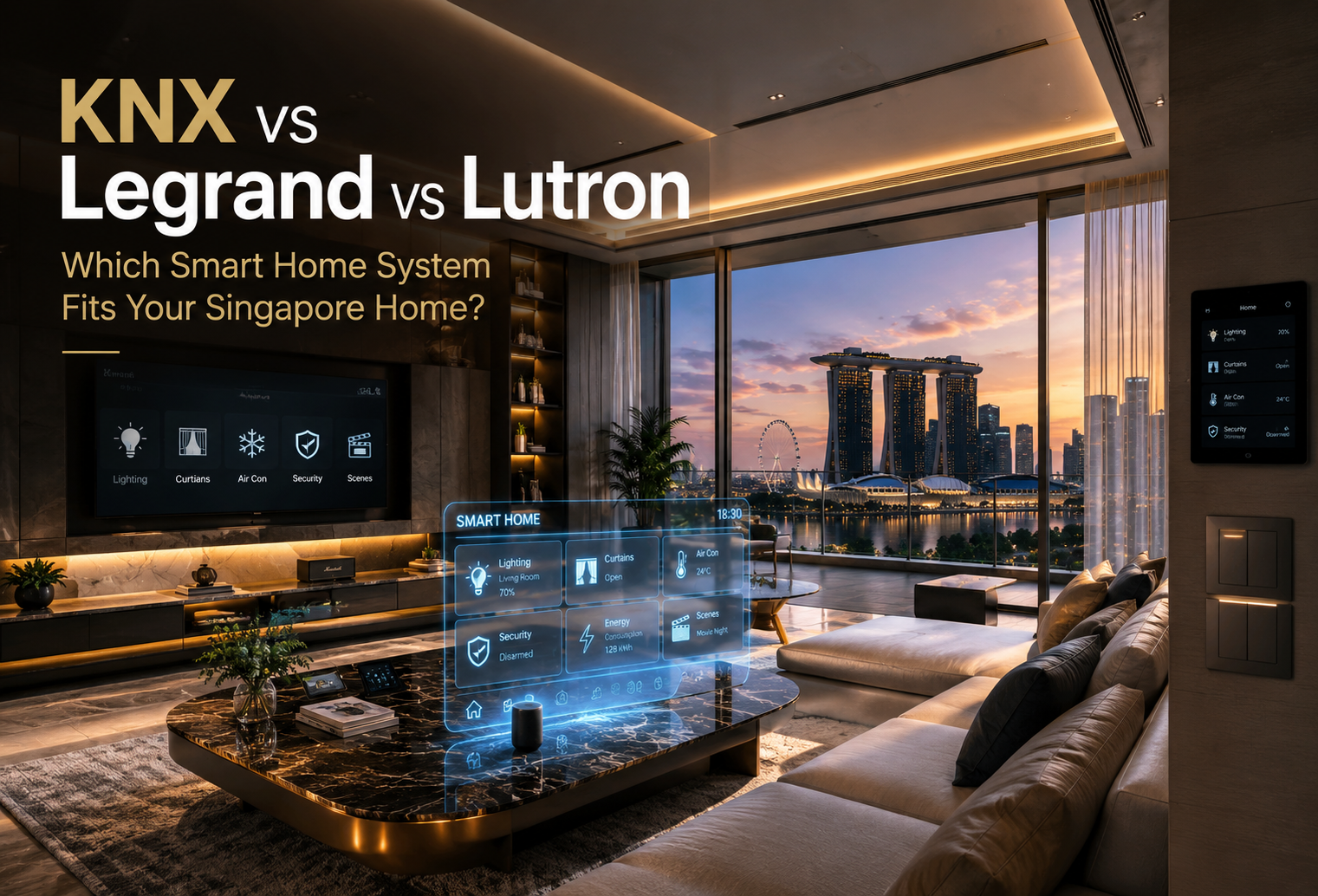
Smart homes are no longer reserved for luxury penthouses or high-end landed properties. Across Singapore, homeowners are increasingly integrating automation into their daily lives, whether through smart lighting, motorised curtains, climate control, or whole-home management systems.
Several factors have contributed to this shift. Homeowners today place greater value on convenience, energy efficiency, and seamless control over their living environment. Instead of manually adjusting multiple switches, air-conditioning settings, or curtain controls throughout the day, a smart home system can automate these tasks based on schedules, occupancy, or personal preferences.
The growing popularity of remote work has also influenced demand. Many homeowners now spend significantly more time at home and are investing in technologies that improve comfort and productivity. Features such as customised lighting scenes, automated climate control, and voice-assisted commands have become practical lifestyle enhancements rather than luxury upgrades.
At the same time, advances in technology have made smart home solutions more accessible than ever. What once required complex programming and expensive hardware can now be implemented across a wide range of property types, from HDB flats and condominiums to large landed homes.
As more homeowners explore automation, one question frequently arises: which smart home system should they choose?
Understanding the Difference Between Smart Home Brands and Automation Standards
One of the most common sources of confusion is the difference between a smart home brand and a smart home automation standard.
Brands such as Legrand and Lutron develop their own products, software, and ecosystems. Homeowners typically purchase devices within that manufacturer’s platform and expand their system using compatible products from the same ecosystem.
KNX, however, operates differently. Rather than being a manufacturer, KNX Singapore is an internationally recognised automation standard used by hundreds of certified brands worldwide. It acts as a common communication protocol that allows devices from different manufacturers to work together within a single smart home environment.
This distinction is important because it directly affects flexibility, scalability, and future upgrade options. While proprietary ecosystems may offer simplicity and ease of deployment, open standards like KNX provide greater freedom when designing and expanding a smart home over the long term.
Understanding these differences is the first step towards selecting the right automation solution for your home.
What Is KNX?
Understanding the KNX Automation Standard
KNX is one of the world’s most established building automation standards. Developed and maintained by the KNX Association, it is recognised internationally and widely adopted across residential, commercial, and hospitality projects.
Unlike traditional smart home platforms that are tied to a single manufacturer, KNX is supported by hundreds of certified companies worldwide. This means homeowners are not restricted to a single product range when designing their automation system.
Today, KNX Singapore is used in everything from private residences and luxury villas to hotels, office towers, airports, and commercial developments. Its reputation has been built on reliability, interoperability, and long-term scalability.
For homeowners researching KNX Singapore solutions, one of the biggest advantages is knowing that the system is based on an established global standard rather than a proprietary technology that may become obsolete in the future.
How KNX Works in a Smart Home Singapore
A KNX system functions as the communication backbone of a smart home. Various devices throughout the property communicate through a shared KNX network. These devices may include:
- Lighting controllers
- Smart switches
- Curtain and blind motors
- Air-conditioning controls
- Motion sensors
- Touch panels
- Security systems
- Energy monitoring devices
Instead of operating independently, all components work together through a unified platform.
For example, pressing a single “Away” button near the entrance can switch off lights, close curtains, adjust air-conditioning settings, and activate selected security functions simultaneously.
Similarly, occupancy sensors can automatically trigger hallway lighting at night, while temperature sensors can adjust cooling levels based on room conditions.
The result is a more intelligent and responsive living environment where different systems operate together rather than as separate technologies.
Why KNX Is Popular in Singapore
Demand for KNX Singapore installations has grown steadily over recent years, particularly among homeowners planning long-term property investments.
One reason is flexibility. Since KNX Singapore supports products from numerous manufacturers, homeowners are not locked into a single ecosystem when expanding or upgrading their automation system.
Another advantage is reliability. Many KNX installations use dedicated communication wiring, providing stable performance that is not heavily dependent on Wi-Fi quality or cloud connectivity.
KNX also aligns well with Singapore’s premium residential market. Larger condominiums, penthouses, and landed homes often require multiple automation functions operating simultaneously. KNX’s architecture is designed to handle this complexity while maintaining consistent performance.
Key Features of a KNX Smart Home System
A properly designed KNX smart home can integrate multiple functions into a single platform.
Common capabilities include:
- Intelligent lighting control
- Automated curtain and blind management
- Air-conditioning automation
- Occupancy-based automation
- Energy monitoring
- Security integration
- Scene control and scheduling
- Mobile and remote access
More importantly, these functions can be combined into customised automation routines that reflect how homeowners actually live.
This level of integration is one of the key reasons why KNX continues to be regarded as one of the most powerful and future-proof smart home solutions available today.
What Is Legrand Smart Home?
Overview of Legrand and BTicino Singapore
Legrand is a global specialist in electrical and digital building infrastructure, offering a wide range of products for residential and commercial environments. In Singapore, many homeowners are familiar with the brand through BTicino Singapore, Legrand’s premium switch and home automation range.
Unlike KNX, which serves as an automation standard, Legrand provides a complete ecosystem of hardware and software designed to simplify smart home adoption.
Its solutions focus on combining functionality, aesthetics, and ease of use, making them particularly attractive to homeowners who want modern automation without the complexity associated with large-scale custom systems.
Main Features and Capabilities
Legrand smart home systems typically support:
- Smart lighting control
- Curtain automation
- Scene creation
- Scheduling
- Remote access
- Voice assistant integration
- Energy monitoring
Many homeowners appreciate the platform’s user-friendly approach. The learning curve is relatively low, and daily operation can usually be managed through a mobile app or voice commands.
For renovation projects and condominium installations, Legrand often provides an effective balance between convenience, design, and affordability.
Pros and Cons of Legrand Smart Home
One of Legrand’s biggest strengths is accessibility. Homeowners can enjoy meaningful automation features without investing in highly customised infrastructure.
The extensive range of BTicino Singapore switches also makes it easier to match different interior design styles.
However, compared to KNX, the ecosystem offers less flexibility when it comes to large-scale customisation and integration with products outside its own platform. While sufficient for many residential projects, homeowners planning extensive future expansion may eventually encounter limitations.
What Is Lutron Smart Home?
Overview of Lutron Singapore
Lutron is widely recognised as one of the world’s leading lighting control specialists. While many smart home companies attempt to cover multiple automation categories, Lutron has built its reputation by focusing heavily on lighting performance.
For decades, architects, lighting designers, and luxury homeowners have relied on Lutron systems to create sophisticated lighting environments that enhance both aesthetics and functionality.
In Singapore, Lutron is particularly popular in premium residential developments where lighting plays a central role in the overall design concept.
Main Features and Capabilities
Lutron systems are known for:
- Precision dimming control
- Intelligent lighting scenes
- Occupancy sensing
- Daylight harvesting
- Automated shading systems
- Smart home integration
The platform delivers an exceptionally polished user experience and is often regarded as one of the most reliable lighting control systems available.
Beyond convenience, Lutron’s technology can also improve energy efficiency by automatically adjusting lighting levels based on occupancy and natural daylight conditions.
Pros and Cons of Lutron Smart Home
Lutron’s greatest advantage is its lighting expertise. Few systems offer the same level of refinement, consistency, and lighting performance.
The platform is also highly reliable and widely trusted within luxury residential projects.
Its primary limitation is that it remains largely lighting-centric. While integration with other smart home technologies is possible, homeowners seeking extensive whole-home automation may find greater flexibility through KNX-based solutions.
KNX vs Legrand vs Lutron: Understanding the Key Differences
At first glance, Legrand, Lutron, and KNX may appear to compete in the same category. However, they approach smart home automation from very different perspectives.
Legrand and Lutron are manufacturers with their own ecosystems and product ranges. KNX, on the other hand, is an automation standard that allows products from multiple manufacturers to work together within a single system.
Understanding these differences is crucial because the right choice depends not only on your budget but also on your long-term automation goals.
System Architecture
KNX Open Protocol
KNX operates as an open protocol platform. Homeowners are free to combine products from different certified manufacturers while maintaining a unified automation system.
This flexibility makes KNX particularly attractive for projects that require long-term scalability and customization.
Legrand Proprietary Ecosystem
Legrand provides a more controlled ecosystem where hardware and software are designed to work together seamlessly. This often results in easier deployment and simplified maintenance.
Lutron Proprietary Ecosystem
Lutron follows a similar approach, focusing on delivering a highly refined user experience within its own lighting control environment.
Flexibility and Customisation
When it comes to customization, KNX clearly offers the greatest flexibility.
A KNX installation can be tailored to virtually any homeowner requirement, from simple lighting scenes to advanced automation involving lighting, curtains, HVAC systems, security, energy monitoring, and entertainment control.
Legrand offers moderate customization suitable for most residential users, while Lutron focuses primarily on lighting and shading automation.
Multi-Brand Compatibility
This is where KNX stands out.
Because KNX is supported by hundreds of certified manufacturers, homeowners are not restricted to a single supplier when upgrading or expanding their system.
Legrand and Lutron users typically remain within their respective ecosystems for maximum compatibility.
Scalability for Future Expansion
Most homeowners do not fully automate their property on day one.
As requirements evolve, additional rooms, devices, and automation functions are often added.
KNX was designed specifically with long-term expansion in mind. The system can grow alongside the property without requiring major architectural changes.
Legrand also supports expansion, though within its own ecosystem. Lutron scales effectively for lighting-focused environments but may require additional integrations when homeowners seek broader automation capabilities.
Reliability and Long-Term Performance
Reliability becomes increasingly important after the renovation is complete.
KNX systems are often deployed in commercial buildings, hotels, and mission-critical environments because of their stability and long operational lifespan.
Lutron also enjoys an excellent reputation for reliability, particularly in lighting control.
Legrand delivers dependable performance for residential applications and remains a popular choice among homeowners seeking a balance between functionality and simplicity.
Installation Complexity
Legrand is generally the easiest system to implement.
Lutron requires specialist knowledge but remains relatively straightforward when compared to large-scale automation systems.
KNX typically involves more planning, programming, and commissioning. While this increases initial complexity, it also enables significantly greater customization and long-term flexibility.
Smart Lighting Control Comparison
For pure lighting control, Lutron remains one of the industry’s strongest performers.
Its dimming technology, scene transitions, and lighting precision are often regarded as benchmarks within the smart lighting sector.
Legrand provides practical and user-friendly lighting automation that satisfies the needs of most homeowners.
KNX can achieve equally advanced lighting automation, but its true strength lies in integrating lighting with broader building functions.
User Experience and Mobile Apps
Legrand prioritizes simplicity and ease of use.
Lutron delivers a highly polished user experience backed by years of lighting control expertise.
KNX user experience depends largely on the chosen interface, touch panel, or application platform. While this introduces additional complexity, it also allows greater personalization.
Why Many Luxury Homes Use KNX as the Automation Backbone
Whole-Home Automation Capabilities
One of the biggest reasons luxury homeowners choose KNX Singapore solutions is the ability to centralize multiple building systems under a single automation platform.
Instead of managing separate applications for lighting, curtains, air-conditioning, and security, homeowners can control everything through one unified ecosystem.
This creates a more seamless experience while reducing the complexity of managing multiple standalone smart devices.
Integration with Lighting, Curtains and Air-Conditioning
KNX Singapore excels when different systems need to work together intelligently.
For example, a morning automation scene could:
- Open curtains automatically
- Adjust lighting levels gradually
- Activate air-conditioning
- Trigger selected appliances
Similarly, an “Away” scene can switch off unnecessary devices, lower energy consumption, and activate security settings with a single command.
These integrated automations are often difficult to achieve consistently across disconnected smart home products.
KNX for Landed Homes
Landed properties typically have more rooms, larger floor areas, and more complex requirements.
Managing lighting circuits, multiple air-conditioning zones, security systems, gate controls, and outdoor lighting can quickly become challenging using entry-level smart home platforms.
KNX Singapore provides the scalability needed to manage these environments efficiently while maintaining system stability over the long term.
KNX for High-End Condominiums
Premium condominiums increasingly incorporate automation into their renovation plans.
KNX allows homeowners to create sophisticated living environments where lighting, climate control, entertainment systems, and security functions operate together seamlessly.
For homeowners planning a long-term residence rather than a short-term renovation upgrade, KNX often becomes an attractive investment due to its flexibility and future-proof architecture.
Cost Comparison: KNX vs Legrand vs Lutron
Initial Investment
Cost remains one of the most important considerations when selecting a smart home system.
Legrand generally offers the lowest entry barrier among the three options. It provides meaningful automation functionality without requiring extensive infrastructure investment.
Lutron typically sits in the premium category due to its specialized lighting technology and design-oriented solutions.
KNX Singapore usually involves the highest upfront investment because of dedicated hardware, programming requirements, and system design considerations.
Long-Term Ownership Costs
While KNX Singapore may require a larger initial investment, many homeowners view it as a long-term infrastructure decision rather than a short-term technology purchase.
Its ability to expand and adapt over time can reduce the need for major system replacements in the future.
Legrand and Lutron also provide strong long-term value, particularly when the homeowner’s requirements remain within the scope of their ecosystems.
Which System Provides Better Value?
The answer depends on the project.
For homeowners seeking practical automation at a reasonable investment level, Legrand often provides excellent value.
For those prioritizing premium lighting control, Lutron remains a compelling option.
For homeowners planning extensive automation, future expansion, and long-term flexibility, KNX frequently delivers the strongest long-term return on investment.
Which Smart Home System Is Best for Different Homeowners?
Best for HDB Flats
Many HDB homeowners prioritize simplicity, affordability, and ease of use.
In these situations, Legrand often provides sufficient automation functionality without introducing unnecessary complexity.
Best for Condominiums
Condominium owners frequently seek a balance between convenience, aesthetics, and future flexibility.
Depending on project requirements, both Legrand and Lutron can perform exceptionally well, while KNX may become attractive for larger or more premium units.
Best for Landed Properties
Landed homes often benefit from KNX Singapore because of their larger size and increased automation requirements.
The ability to manage multiple systems through a single platform becomes increasingly valuable as property complexity grows.
Best for Luxury Homes
Many luxury homes use KNX Singapore as the automation backbone because it supports comprehensive integration across lighting, climate control, security, entertainment, and energy management systems.
Its open architecture also provides greater freedom when selecting premium switches, touch panels, and control interfaces.
Best for Future-Proofing
If long-term scalability is a priority, KNX Singapore remains one of the strongest choices available.
Because it is an internationally recognised automation standard rather than a proprietary ecosystem, homeowners can continue expanding and upgrading their system without being tied to a single manufacturer.
Advantages of Choosing KNX Singapore
Open Protocol Flexibility
One of the biggest advantages of KNX Singapore solutions is flexibility.
Unlike proprietary smart home ecosystems that lock homeowners into a single manufacturer, KNX allows products from hundreds of certified brands to operate together within the same system. This gives homeowners greater freedom when selecting switches, touch panels, sensors, actuators, and future upgrades.
The result is a smart home that can evolve alongside changing technologies and lifestyle requirements.
Multi-Brand Freedom
With KNX Singapore, homeowners are not restricted to one supplier for every component.
For example, a homeowner may choose premium designer switches from one manufacturer, motion sensors from another, and advanced touch panels from a third—all while maintaining a fully integrated automation system.
This level of freedom is one of the reasons KNX has remained relevant for decades despite rapid technological changes.
Reliable Wired Infrastructure
Many KNX Singaporeinstallations utilise dedicated communication wiring, creating a highly stable automation environment.
Unlike consumer-grade smart devices that depend heavily on Wi-Fi connectivity, KNX systems continue operating reliably even when network conditions fluctuate.
This reliability has made KNX Singapore a preferred choice not only for homes but also for hotels, office buildings, airports, and commercial developments worldwide.
Future-Proof Technology
Technology changes quickly, but infrastructure decisions often remain in place for many years.
Because KNX Singapore is an internationally recognised automation standard rather than a single manufacturer’s platform, homeowners are less exposed to the risks associated with discontinued products or ecosystem changes.
This makes KNX particularly attractive for homeowners planning long-term property ownership.
Long-Term Scalability
A smart home should not become obsolete after a few years.
KNX Singapore allows homeowners to begin with essential automation functions and gradually expand the system over time. New rooms, devices, and automation scenarios can be added without replacing the entire infrastructure.
For larger homes and growing families, this scalability often becomes a significant advantage.
Common Mistakes When Choosing a Smart Home System
Focusing Only on Price
One of the most common mistakes homeowners make is comparing systems solely based on installation cost.
While budget is important, focusing only on initial pricing can lead to limitations later when additional automation features or expansion requirements arise.
A lower-cost solution may not always deliver the best long-term value.
Ignoring Future Expansion Requirements
Many homeowners initially automate only a few functions but eventually want additional features.
Without considering future expansion during the planning stage, upgrades can become more complicated and expensive than necessary.
Choosing a scalable platform from the beginning helps avoid these challenges.
Choosing a System Before Planning Automation Goals
Technology should support lifestyle goals, not dictate them.
Before selecting any platform, homeowners should clearly define what they want the system to achieve. Whether the goal is lighting automation, energy management, security integration, or whole-home control, having a clear vision helps guide the decision-making process.
Hiring an Inexperienced Integrator
Even the best technology can underperform if poorly designed or installed.
An experienced smart home integrator understands system architecture, user experience, future scalability, and ongoing support requirements. Proper planning often has a greater impact on satisfaction than the specific platform chosen.
Future Trends in Smart Home Automation
AI-Powered Home Automation
Artificial intelligence is beginning to transform how smart homes operate.
Rather than relying solely on predefined schedules, future systems will increasingly learn user behaviour and automatically adjust lighting, climate control, and energy consumption based on daily routines.
Energy Management and Sustainability
As energy costs continue to rise, homeowners are becoming more interested in intelligent energy management.
Future smart homes will play a larger role in monitoring energy usage, optimising consumption patterns, and supporting sustainable living practices.
Smarter Building Integration
The next generation of automation systems will further blur the lines between lighting, security, climate control, entertainment, and energy management.
Instead of operating as separate systems, they will increasingly function as a unified ecosystem.
The Future of KNX in Singapore
As demand for premium automation grows, KNX Singapore is expected to remain a strong choice for homeowners seeking long-term flexibility and advanced functionality.
Its open architecture, global manufacturer support, and proven track record position it well for future developments in smart building technology.
Why Work With a KNX Smart Home Specialist
System Design and Planning
Every property has different requirements.
A professional KNX Singapore specialist can assess the property’s layout, electrical infrastructure, and automation goals before recommending an appropriate system design.
This planning stage helps ensure the technology aligns with both current and future needs.
Professional Installation and Programming
KNX systems offer extensive customization capabilities, but achieving optimal performance requires proper configuration.
Professional programming ensures that automation scenarios, integrations, and user interfaces operate smoothly from day one.
Long-Term Support and Expansion
One of the strengths of KNX is its ability to expand over time.
Working with an experienced integrator provides access to ongoing support, future upgrades, and system optimisation as homeowner requirements evolve.
Why Living Art Recommends a Tailored Smart Home Approach
Matching the Right Technology to Your Lifestyle
No single smart home solution is ideal for every homeowner.
Some homeowners prioritise simplicity and convenience. Others focus on luxury lighting experiences. Some require advanced whole-home automation with room for future expansion.
The right solution depends on the property, budget, and lifestyle objectives.
When KNX Makes Sense
KNX Singapore is often an excellent choice for homeowners seeking a future-proof automation platform with extensive customization options.
It is particularly suitable for larger homes, premium residential projects, and homeowners who anticipate expanding their automation requirements over time.
When Legrand or Lutron May Be a Better Fit
Legrand may be more suitable for homeowners seeking a straightforward and cost-effective smart home solution.
Lutron may be the preferred option for projects where lighting quality and sophisticated lighting control are the primary priorities.
At Living Art, our goal is not to promote a single technology but to help homeowners identify the solution that best fits their long-term needs.
Final Verdict: Is KNX Worth It?
When to Choose KNX
Choose KNX Singapore if you want a highly scalable automation platform capable of integrating lighting, air-conditioning, curtains, security, energy management, and future smart home technologies within a single ecosystem.
When to Choose Legrand
Choose Legrand if you want user-friendly automation, attractive switch designs, and practical smart home functionality without the complexity of a fully customised automation platform.
When to Choose Lutron
Choose Lutron if premium lighting control, elegant dimming performance, and sophisticated lighting scenes are among your top priorities.
Making the Right Decision for Your Home
The best smart home system is not necessarily the one with the most features.
It is the one that aligns with your property’s requirements, lifestyle goals, future expansion plans, and investment expectations.
For homeowners seeking maximum flexibility and long-term scalability, KNX remains one of the strongest smart home solutions available in Singapore today.
Frequently Asked Questions
What is KNX Singapore?
KNX Singapore refers to smart home and building automation solutions built on the KNX international standard. It allows lighting, curtains, air-conditioning, security systems, sensors, and other technologies to communicate through a unified automation platform.
Is KNX better than Lutron?
Not necessarily. KNX Singapore offers broader automation capabilities and greater flexibility, while Lutron specialises in premium lighting control and lighting-focused user experiences.
Is KNX better than Legrand?
The answer depends on your requirements. KNX provides greater scalability and customization, while Legrand focuses on delivering practical and user-friendly smart home functionality.
How much does a KNX smart home cost in Singapore?
Costs vary depending on property size, number of controlled devices, level of customization, and project complexity. Larger landed properties typically require a higher investment than smaller condominium installations.
Is KNX suitable for HDB flats?
Yes. Although KNX is often associated with luxury homes, it can also be implemented in HDB flats and condominiums where homeowners want advanced automation and long-term flexibility.
Can KNX work with Apple HomeKit and Google Home?
Yes. Many KNX Singapore installations can be integrated with popular smart home ecosystems such as Apple HomeKit, Google Home, and Amazon Alexa through compatible gateways and integrations.
Why is KNX commonly used in luxury homes?
Luxury homes often require multiple systems to operate together seamlessly. KNX Singapore provides the flexibility, reliability, and scalability needed to manage complex automation requirements across large properties.
Is KNX worth the investment?
For homeowners seeking a future-proof smart home platform with extensive customization and expansion potential, KNX is often considered one of the most valuable long-term investments in residential automation.