5 Lessons from 10+ Smart Home Automation Singapore (Real Insights from a Smart Home Provider)
Introduction: What We Learned from Real Smart Home Automation Projects in Singapore
Over the past few years at LivingArt.sg, we’ve worked on more than 10 smart home projects across Singapore — from compact HDB flats to high-end landed properties. And if there’s one thing that consistently stands out, it’s this: what works on paper doesn’t always work in real life.
Homeowners often come in with a list of features they’ve seen online — voice control, automated lighting, remote access — but the real value only shows up when those features fit seamlessly into daily routines. A smart home shouldn’t feel like technology you have to manage. It should quietly support how you already live.
If you’re planning a smart home, renovating, or simply exploring your options, these lessons will help you avoid common pitfalls and make better decisions from the start.
What Is a Smart Home Automation System? (Beginner Foundation)
Definition of smart home automation
Instead of manually switching lights, adjusting air conditioning, or checking security cameras one by one, a smart home connects these functions into a single system. You can control them through an app, a wall panel, or even automate them to run on their own.
But beyond convenience, it’s really about coordination. Lights, climate, security, and entertainment systems working together — not as separate devices, but as one integrated environment.
Key components: devices, hubs, protocols, and apps
First, the devices — things like smart switches, sensors, locks, and cameras. These are what you physically interact with.
Then comes the system layer. This could be a central controller, a hub, or a server depending on the setup. It’s what allows different devices to “talk” to each other.
Behind that, there are communication protocols — wired systems like KNX, or wireless ones like Zigbee, Z-Wave, or WiFi. This part is often overlooked, but it plays a big role in reliability.
Finally, there’s the interface. The app on your phone, a wall-mounted panel, or voice control through assistants like Google Home or Apple HomeKit.
Each layer matters. And how they’re put together determines whether your smart home feels seamless or frustrating.
Popular smart home systems in Singapore (Google Home, Apple HomeKit, KNX, etc.)
On one side, consumer ecosystems like Google Home and Apple HomeKit. These are more accessible, often wireless, and easier to start with. Many homeowners begin here because of lower upfront cost.
On the other side, there are professional-grade systems like KNX. These are typically wired, more stable, and designed for long-term use — especially in larger homes or luxury projects.
There’s no single “best” system. It depends on the homeowner’s expectations, the property type, and how deeply they want automation integrated into their space.
Difference between DIY smart home automation vs professional installation
DIY smart home automation setups are great for experimenting. You can buy a few devices, connect them, and start automating simple tasks. It works — up to a point.
But once you scale beyond a few rooms, things start to break down. Devices don’t sync properly. Automations conflict. Apps become cluttered. And troubleshooting becomes a regular activity.
Professional smart home installation approaches things differently. It starts with planning — understanding how you live, mapping out control points, designing scenes that make sense.
Why Smart Home Adoption Is Growing in Singapore
Rising demand for smart home solutions in Singapore
Smart home automation in Singapore is no longer limited to luxury homeowners. More HDB and condo owners are exploring it early in their renovation process. It’s becoming part of the baseline conversation, not an afterthought.
The awareness is higher now. People understand what’s possible — and more importantly, what’s practical.
Lifestyle factors: convenience, security, and energy efficiency
Convenience is usually the first driver. Being able to control lighting, air conditioning, and appliances without moving around the house sounds simple, but once experienced, it’s hard to go back.
Security is another key factor. Smart locks, motion sensors, and real-time monitoring give peace of mind, especially for families or frequent travellers.
Then there’s energy efficiency. With electricity costs rising, automated scheduling and smarter usage patterns help reduce unnecessary consumption without constant manual control.
Integration with modern interior design and luxury living
Modern interiors in Singapore are becoming cleaner, more minimal. Smart home automation systems support that — fewer switches on the wall, more centralized control, hidden wiring, and seamless integration.
In higher-end homes, automation is no longer just functional. It’s part of the overall living experience.
Government push and smart nation initiatives
While it doesn’t directly dictate home automation choices, it shapes the broader ecosystem — better infrastructure, stronger connectivity, and a population that’s more comfortable with technology.
Lesson #1: Start with the Right Infrastructure (Not Just Gadgets)
Why wiring and system planning comes first
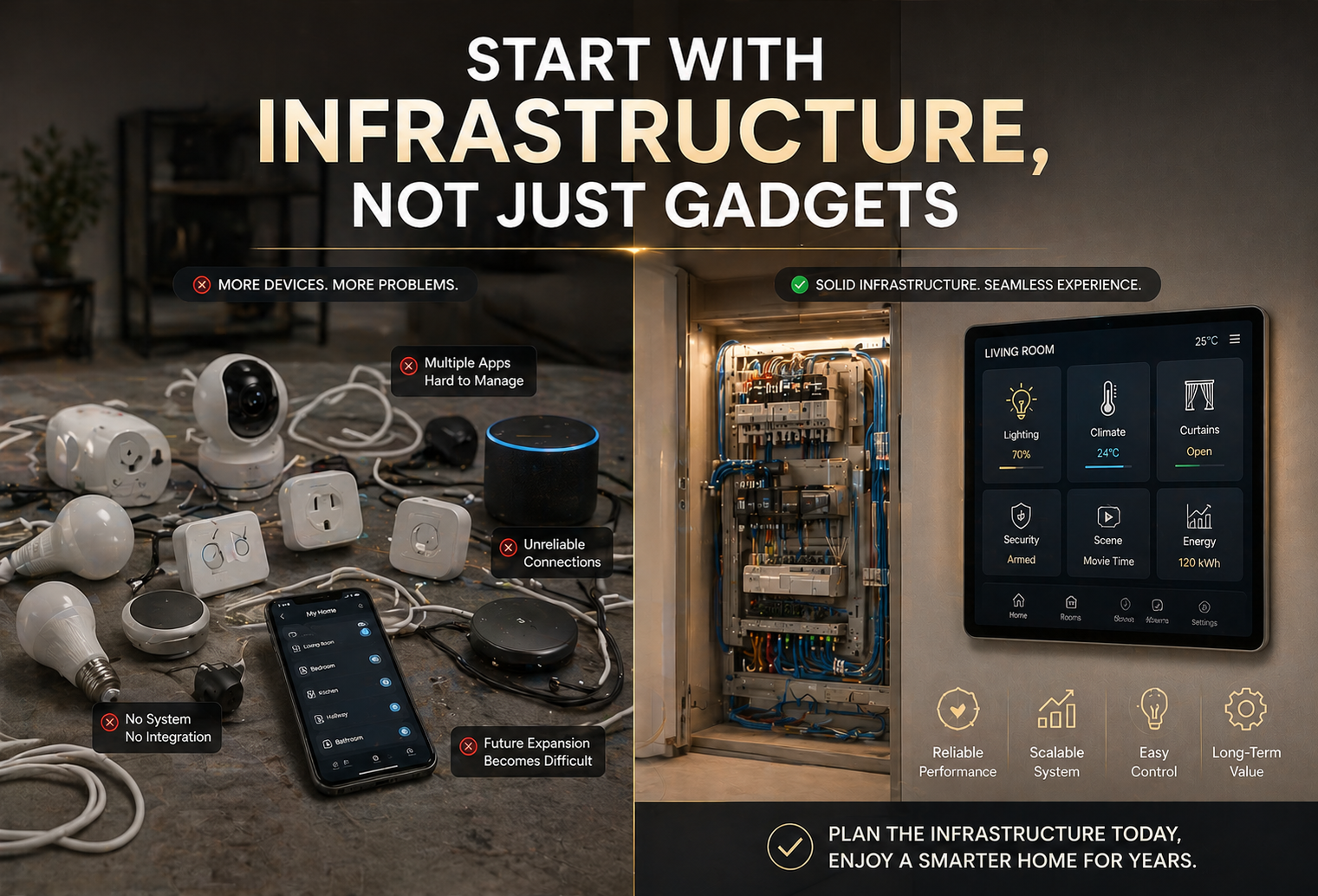
A well-planned smart home automation system starts with infrastructure. Wiring layout, control points, system architecture — these decisions determine how flexible and reliable your setup will be.
Once renovation is done, changing these becomes difficult and expensive.
Importance of centralized vs decentralized systems
This is where system design comes in.
Centralized systems — like KNX — rely on a structured backbone. Everything connects into a unified system, which makes it more stable and easier to manage long-term.
Decentralized setups, often seen in DIY environments, rely on individual devices communicating over wireless networks. It’s more flexible initially, but can become fragmented over time.
Neither is inherently wrong. But choosing without understanding the trade-offs often leads to limitations later.
Retrofitting vs new build considerations
The approach also changes depending on the property.
Challenges in older homes (condos, HDB)
For existing homes, retrofitting is usually the constraint. You’re working around existing wiring, limited space, and sometimes restricted renovation scope. Wireless solutions are often used here, but they require careful planning to avoid connectivity issues.
Opportunities in new developments
New builds, on the other hand, offer a clean slate. This is where proper infrastructure planning really pays off. You can run the right cables, position control panels strategically, and design the system from the ground up.
The difference in long-term performance is significant.
And this is exactly why infrastructure — not gadgets — should always come first.
Lesson #2: User Experience Matters More Than Features
Avoiding over-complicated automation setups
One pattern we’ve seen repeatedly — especially with first-time smart home users — is the tendency to overbuild.
It usually starts with excitement. Homeowners want everything automated: lights, curtains, aircon, music, security, even small appliances. On paper, it sounds impressive. In reality, it often becomes overwhelming.
We’ve walked into homes where there are five different ways to turn on a single light — app, voice, switch, sensor, and automation schedule. Instead of feeling “smart,” it creates hesitation. People stop using the system the way it was intended.
A smart home automation should reduce friction, not introduce it. The goal isn’t to automate everything. It’s to automate the right things — the ones you actually use daily.
Designing for real daily habits (not just “cool” features)
This is where experience makes a difference. During planning, we always ask simple questions: What time do you wake up? Do you prefer dim lighting at night? Do you usually turn on the aircon before entering the room?
These aren’t technical questions, but they shape the entire system.
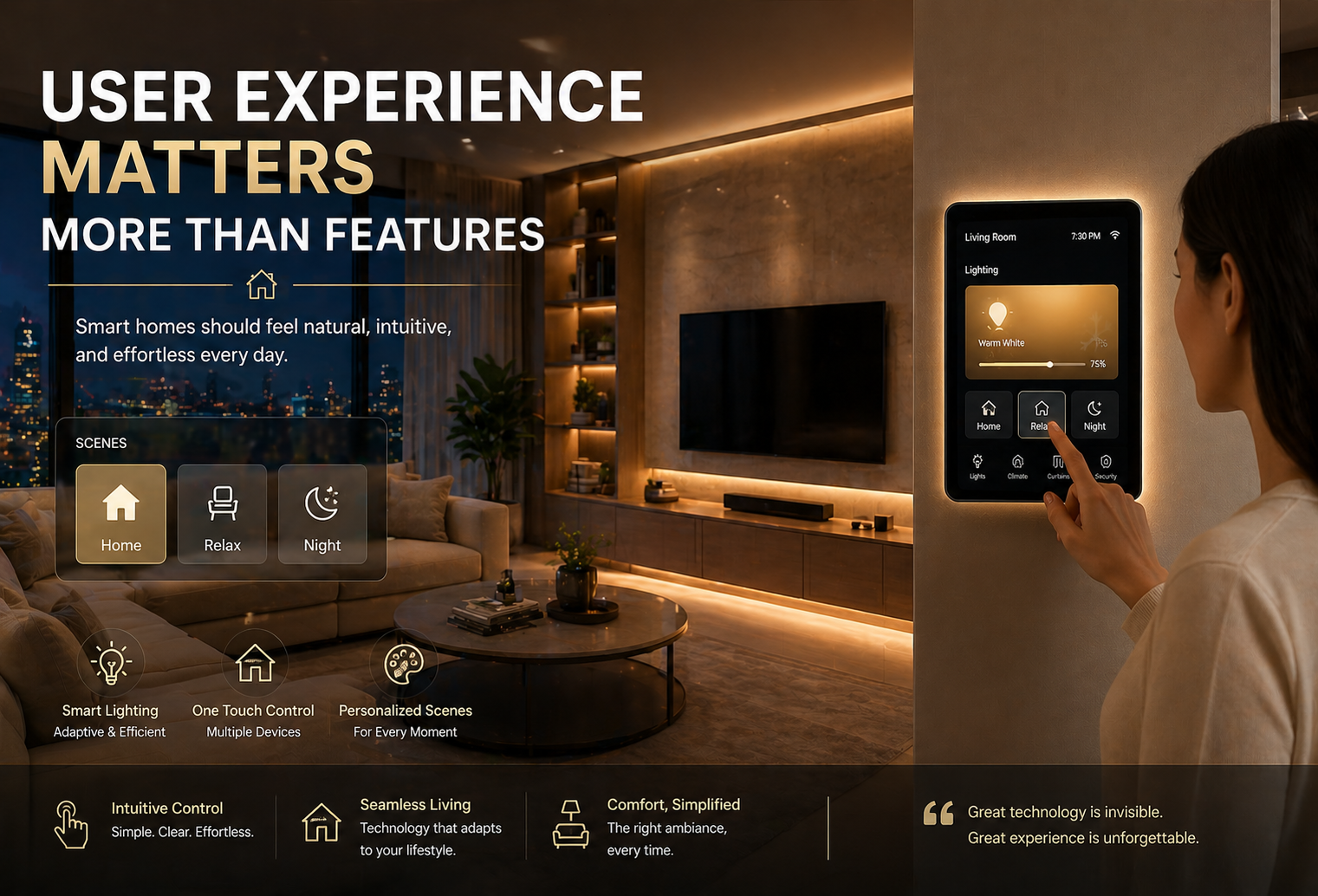
For example, a “Good Night” scene sounds straightforward — turn off lights, close curtains, adjust aircon. But how it behaves depends on the user. Some prefer complete darkness, others want subtle ambient lighting. Some want security armed automatically, others don’t.
When automation reflects real habits, it feels natural. When it doesn’t, it gets ignored.
Creating intuitive control (apps, switches, voice)
Control methods matter more than most people expect.
Apps are powerful, but they shouldn’t be the only way to interact with your home. In many cases, physical switches still provide the fastest, most intuitive control — especially for guests or older family members.
Voice control adds convenience, but it’s not always reliable in every situation. Background noise, accents, or even simple phrasing differences can affect performance.
That’s why a good smart home system balances all three — app, switch, and voice — without forcing users into one method.
Consistency is key. If one room behaves differently from another, users notice immediately.
Lesson #3: Integration Is Everything (Avoid Fragmented Systems)
Risks of mixing incompatible smart devices
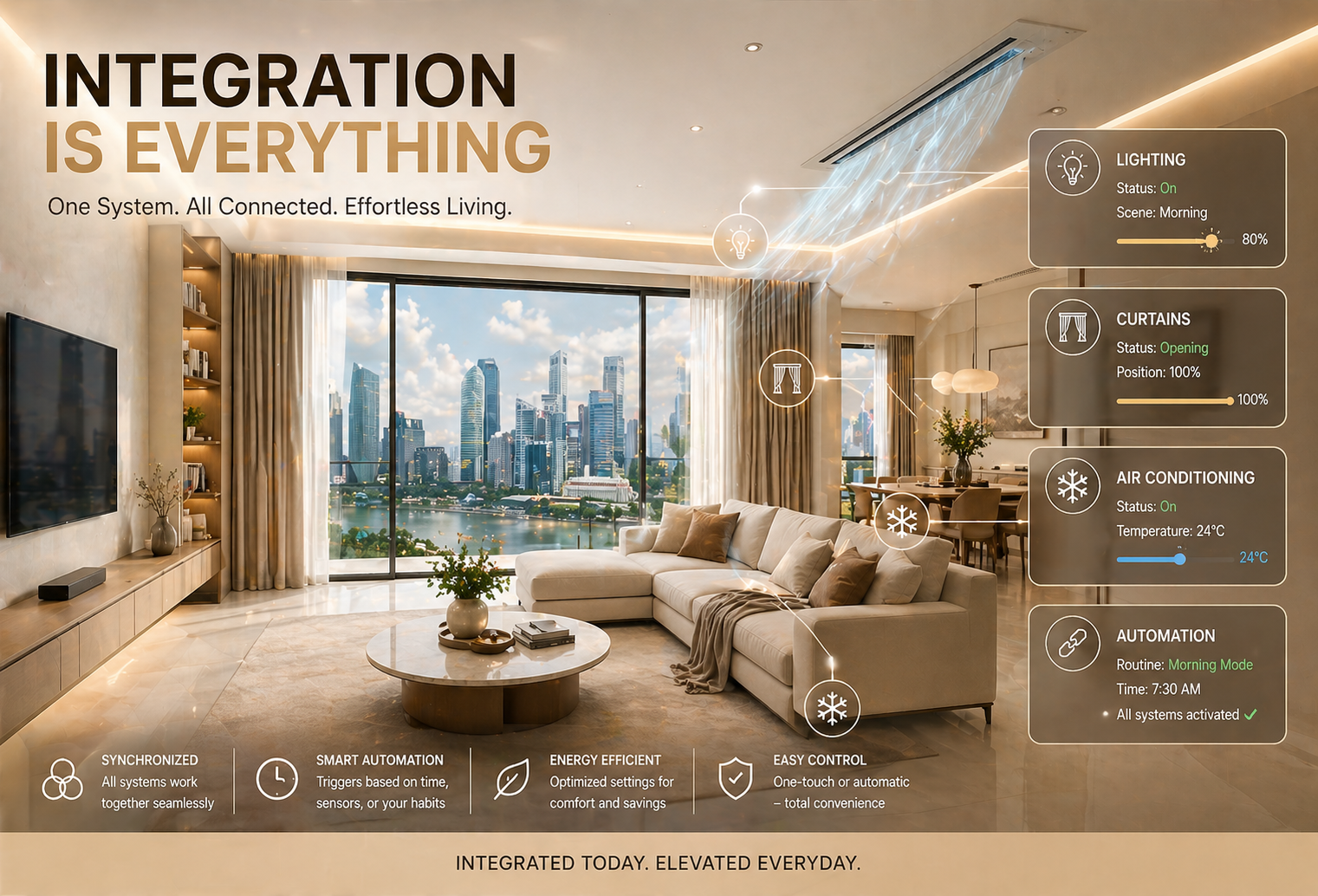
Homeowners buy devices over time — a smart lock from one brand, lighting from another, cameras from a third. Individually, each product works well. But together, they don’t communicate properly.
This leads to multiple apps, inconsistent controls, and limited automation possibilities.
For example, your motion sensor might not trigger your lights because they belong to different ecosystems. Or your smart lock doesn’t integrate with your security system.
At that point, the “smart home” becomes a collection of smart devices — not a cohesive system.
Importance of a unified smart home ecosystem
Instead of thinking in terms of products, we design around ecosystems. Everything is selected to work within a unified framework — whether it’s a wired system like KNX or a carefully chosen wireless ecosystem.
This allows for deeper automation. Lights can respond to motion sensors. Curtains can adjust based on time of day. Security systems can trigger alerts and lighting simultaneously.
The experience becomes seamless because everything is connected at a system level.
Wired vs wireless integration explained
This is where the technical side comes in, but it doesn’t have to be complicated.
Wired systems are typically more stable. They don’t rely on WiFi strength or signal interference. Once installed properly, they perform consistently over time.
Wireless systems are more flexible and easier to install, especially for existing homes. But they depend on network quality, and as more devices are added, performance can vary.
In Singapore, we often use a hybrid approach wired and wireless system — combining the stability of wired systems with the flexibility of wireless where needed.
How we ensure seamless automation across systems
From a project standpoint, integration starts during planning, not installation. We map out all systems — lighting, aircon, security, entertainment — and define how they should interact.
Then we choose components that support those interactions. This avoids the common “patchwork” problem where devices are added without a clear structure.
In the long run, this approach saves time, reduces troubleshooting, and creates a much smoother user experience.
Lesson #4: Security & Reliability Cannot Be Compromised
Common security risks in smart homes
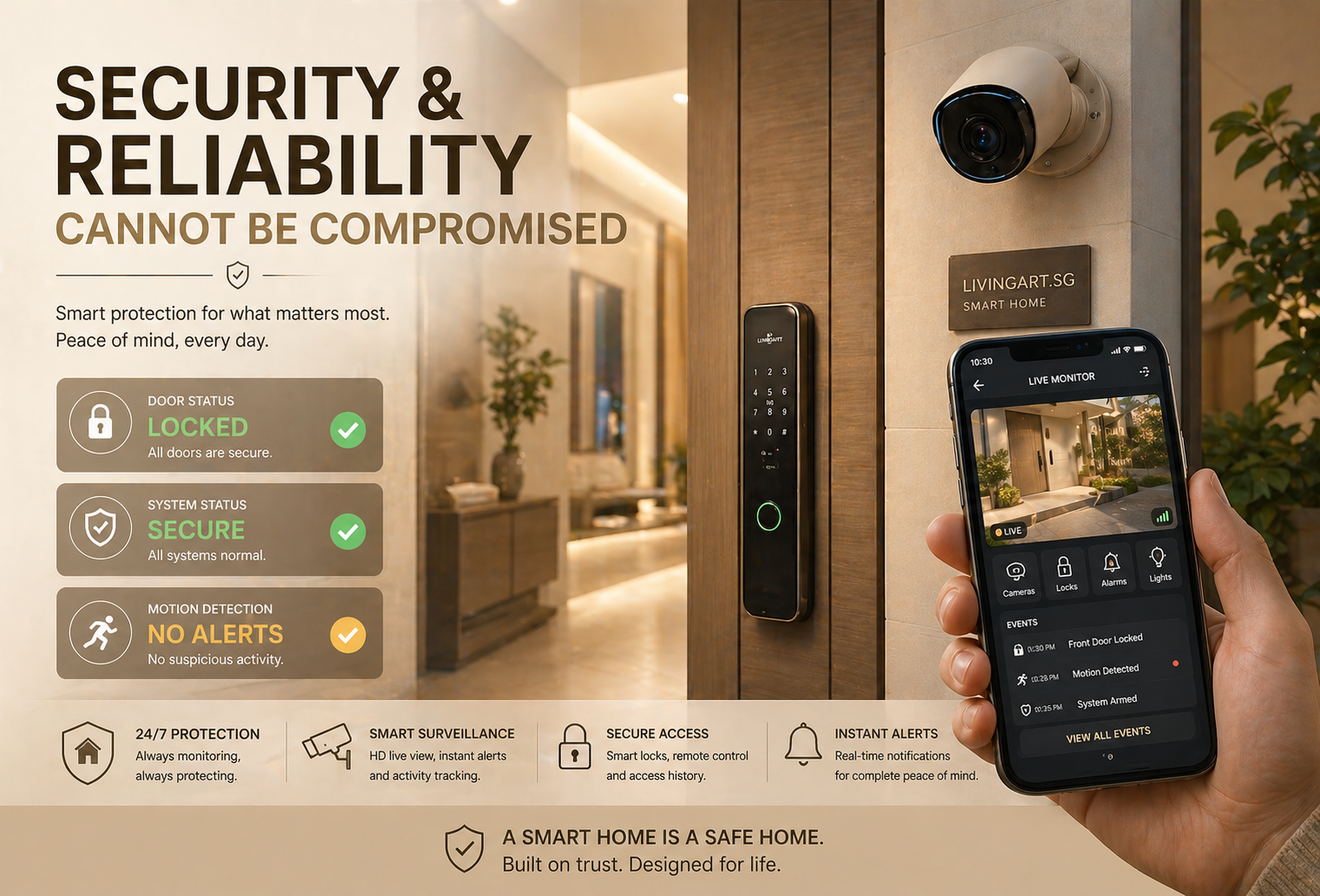
As smart homes become more connected, security becomes a real concern. It’s not just about physical security like locks and cameras. It’s also about network vulnerabilities — unsecured devices, weak passwords, or poorly configured systems.
We’ve seen cases where homeowners unknowingly expose their systems because everything is connected through basic home WiFi without proper segmentation. While major breaches are rare, the risk is there. And it’s something that should be addressed early.
Importance of secure networks and encrypted systems
A properly designed smart home includes network planning. This often means separating smart home devices from general internet usage, using secure protocols, and ensuring that data transmission is encrypted.
Professional systems typically have stronger built-in security measures compared to consumer-grade devices. It’s not something most homeowners think about initially, but it makes a significant difference in long-term safety.
Offline vs cloud-based systems: pros and cons
Another key consideration is how your system operates. Cloud-based systems rely on internet connectivity. They offer remote access and easy updates, but if the internet goes down, functionality may be limited.
Offline systems, often found in wired setups, continue to operate even without internet. Core functions like lighting and automation still work locally. Each has its place. In many projects, we design systems that maintain essential functions offline, while still allowing remote access when needed.
Backup systems and fail-safe design
Reliability isn’t just about uptime — it’s about how the system behaves when something goes wrong. What happens if a device fails? If the network drops? If power is interrupted? A well-designed smart home includes fail-safe mechanisms.
For example, physical switches still work even if the system is offline. Critical functions aren’t dependent on a single point of failure. These details may seem minor during planning, but they’re what separate a reliable system from one that becomes frustrating over time.
Lesson #5: Professional Planning Saves More Than It Costs
Hidden costs of DIY smart home setups
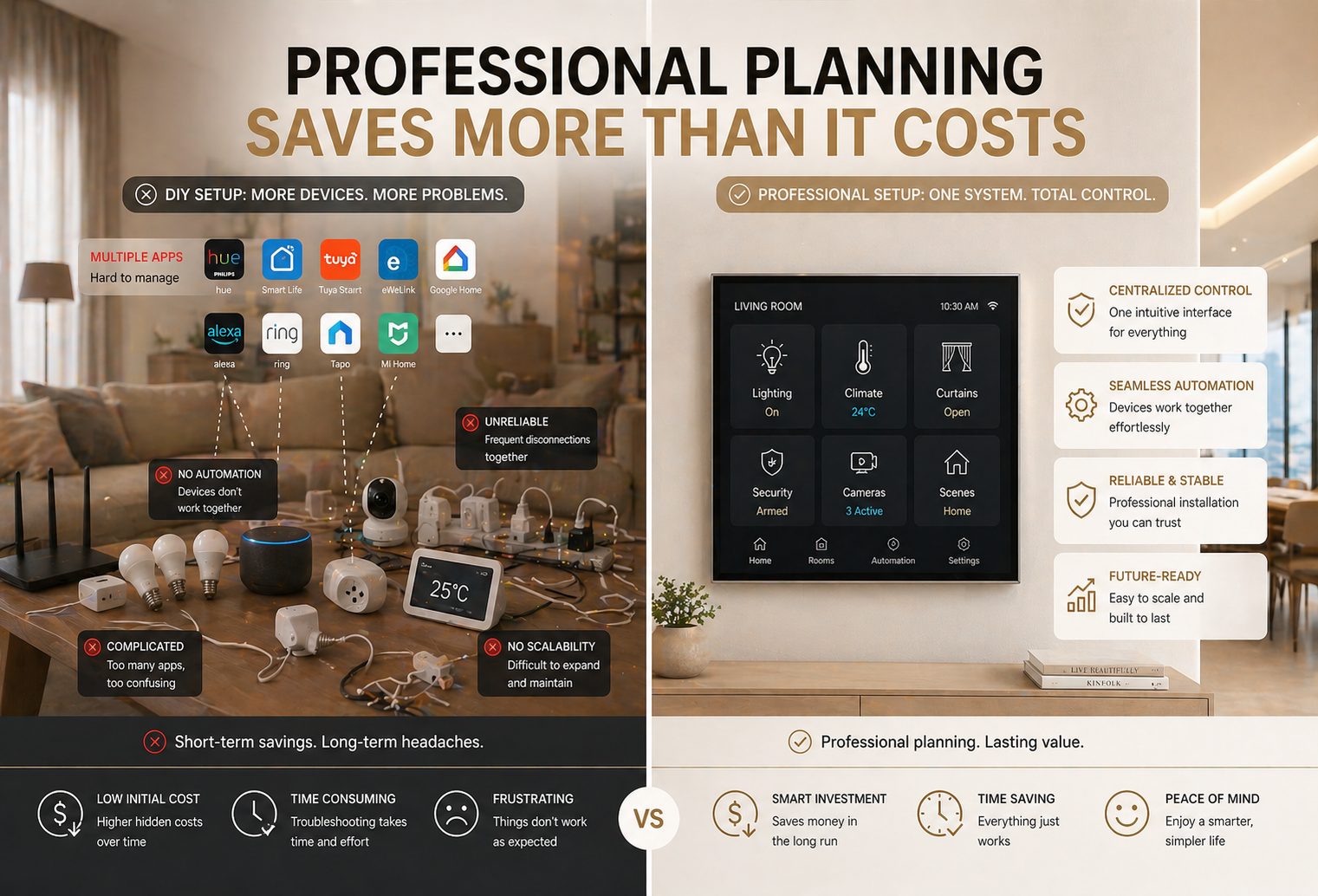
At first glance, DIY smart home setups seem more cost-effective. You can start small, buy devices gradually, and avoid upfront system design costs. But over time, hidden costs start to appear.
Devices get replaced because they don’t integrate well. Additional hubs are needed. Time is spent troubleshooting connectivity issues.
What started as a “budget-friendly” approach often ends up costing more — not just financially, but in time and frustration.
Long-term maintenance and scalability
Smart homes aren’t static. Over time, homeowners want to expand — add more rooms, upgrade features, integrate new technologies.
Without proper planning, scaling becomes difficult. Systems become fragmented, and compatibility issues increase. A professionally planned system accounts for future expansion from the start. Even if you don’t implement everything immediately, the foundation is there.
Why homeowners in Singapore choose smart home consultants
In Singapore, where renovation timelines are tight and space is limited, mistakes can be costly. That’s why many homeowners choose to work with smart home providers early in the process.
It’s not just about installation. It’s about coordination — working alongside interior designers, electricians, and contractors to ensure everything fits together. This level of planning reduces rework and ensures a smoother overall project.
ROI of a properly designed smart home system
The value of a smart home isn’t just in its features. It shows up in daily convenience, reduced energy waste, improved security, and even property value.
More importantly, it shows up in how effortless the experience feels. When everything works the way it should — without constant adjustment — that’s when the investment truly pays off.
And in most cases, that outcome comes from good planning, not just good products.
Limitations of Smart Home Systems (What to Consider)
Initial setup cost and investment
Smart home systems do require upfront investment. Depending on the scale, costs can range from basic setups to more comprehensive systems involving wiring and centralized control.
For many homeowners, this is the first consideration — and sometimes the biggest barrier. The key is understanding what you’re paying for. It’s not just devices, but design, integration, and long-term reliability.
Learning curve for new users
Even well-designed systems require some level of adjustment. New users may take time to get used to app controls, automation logic, or scene-based interactions.
This is especially true in households with multiple users — different preferences can create small friction points initially. However, once routines settle, most people adapt quickly.
Dependence on internet and connectivity
For wireless and cloud-based systems, connectivity plays a major role. If the network is unstable, performance can be affected. Delays in response, failed commands, or inconsistent automation can occur.
That’s why network quality is often part of the overall system design. It’s not just about having WiFi — it’s about having the right infrastructure to support multiple connected devices.
Compatibility and upgrade challenges
Technology evolves quickly. New devices, updated platforms, and changing standards can affect compatibility over time.
Without proper planning, upgrading parts of the system can become complicated. This is where choosing the right ecosystem early on makes a difference. A well-structured system allows for gradual upgrades without needing a complete overhaul.
Smart Home System Comparison (Choosing the Right Setup)
Wired vs wireless smart home systems
This is one of the most common decisions homeowners face. Wired systems are generally more stable. They’re less affected by interference and don’t rely on WiFi performance.
However, they require more planning and are typically implemented during renovation or new builds. Wireless systems, on the other hand, are easier to install and more flexible. They’re ideal for retrofitting existing homes. The trade-off is long-term reliability and scalability.
KNX vs consumer-grade systems (Google Home, Alexa)
KNX represents a professional-grade, wired approach. It’s highly customizable, extremely stable, and widely used in larger or more complex projects. But it comes with higher upfront cost and requires professional setup.
Consumer-grade systems like Google Home or Alexa are more accessible. They’re suitable for simpler setups and offer quick deployment. The limitation is in depth of integration and long-term consistency.
Open ecosystem vs closed ecosystem
Another important factor is ecosystem flexibility. Open ecosystems allow integration across different brands and systems. This provides more freedom but requires careful planning.
Closed ecosystems are more controlled. Everything is designed to work within a single platform, which can improve stability but limits options. Choosing between the two depends on how much flexibility you need versus how much simplicity you prefer.
Which system is best for Singapore homes?
There isn’t a one-size-fits-all answer. For smaller homes or basic automation needs, wireless systems may be sufficient.
For larger properties, or homeowners looking for a more seamless and long-term solution, wired or hybrid systems tend to perform better. Ultimately, the “best” system is the one that aligns with your lifestyle, property type, and expectations — not just the most popular option.
Common Mistakes to Avoid When Automating Your Home
Installing devices without a master plan
One of the most frequent mistakes is starting without a clear strategy. Homeowners purchase devices individually, hoping to connect everything later. This often leads to compatibility issues and fragmented control. A structured plan ensures all components work together from the start.
Choosing based on price instead of reliability
Cost is important, but focusing solely on price can create long-term problems. Cheaper devices may lack stability, security, or integration capabilities. Over time, replacements and troubleshooting can outweigh initial savings.
Ignoring future scalability
Many setups are designed only for current needs. As homeowners expand their systems, limitations become apparent — devices can’t integrate, or infrastructure doesn’t support additional features. Planning for future growth avoids these constraints.
Over-automation leading to poor user experience
Too much automation can be just as problematic as too little. Complex rules, excessive scenes, and overlapping triggers create confusion. When the system behaves unpredictably, users lose trust and revert to manual control.
Not working with experienced smart home providers
Finally, underestimating the value of experience can lead to avoidable issues. Smart home systems involve coordination across multiple elements — electrical, networking, software, and user experience.
Working with experienced providers helps align all these aspects, reducing risk and improving overall outcomes.
Expert Tips from LivingArt.sg (Pro Strategies)
Plan your smart home during renovation stage
If there’s one piece of advice we consistently give, it’s this — don’t treat smart home as an add-on.
The best results always come when automation is planned alongside renovation, not after. This allows proper coordination with electricians, interior designers, and contractors.
We’ve seen cases where homeowners decided to “add smart features later,” only to realize key wiring or control points were already fixed. At that stage, options become limited or more costly to implement.
Planning early doesn’t mean committing to everything upfront. It simply means creating the right foundation so you have flexibility later.
Focus on high-impact automation first (lighting, security)
From experience, lighting and security tend to deliver the highest immediate value. They’re used daily, easy to understand, and noticeably improve convenience.
Once those are in place, homeowners naturally identify what else they want to automate — whether it’s climate control, curtains, or entertainment.
This phased approach keeps the system practical and avoids unnecessary complexity early on.
Keep user interface simple and consistent
We always emphasize consistency across controls — the same logic, the same layout, the same behavior throughout the home. If one room works differently from another, it creates confusion.
For example, if a “single press” turns on lights in one room but does something else in another, users hesitate.
Invest in quality infrastructure, not just devices
Devices are the visible part of a smart home, but infrastructure is what holds everything together.
Reliable wiring, stable networks, and properly configured systems make a much bigger difference than choosing between similar-looking devices.
It’s tempting to focus on visible features — sleek panels, voice control, app design. But long-term performance depends on what’s behind the scenes.
Always test real-life scenarios before finalizing setup
Before handing over a project, we simulate real usage — entering the home, switching between scenes, adjusting settings at different times of day.
Why Choose a Professional Smart Home Provider in Singapore
Role of system integrators vs installers
There’s an important distinction many homeowners don’t realize. An installer focuses on setting up devices. A system integrator focuses on how everything works together.
Smart homes are not just about installation. They involve coordination across multiple systems — lighting, security, climate, networking — and how these interact. This is where system integrators add value. They design the logic behind the system, ensuring it functions as a cohesive whole.
End-to-end solution: design, installation, support
Working with a professional provider typically covers the full lifecycle. It starts with consultation and system design. Then moves into installation and configuration. And continues with testing, handover, and ongoing support.
This end-to-end approach reduces the chances of misalignment between different contractors or systems. It also provides a single point of accountability.
Customization based on lifestyle and property type
Every home is different. A compact condo, a family HDB, and a landed property all have different requirements — not just in size, but in how people use the space.
Professional providers tailor the system based on these factors. Instead of applying a standard setup, the design reflects the homeowner’s lifestyle — which rooms are used most, how routines flow, what level of automation is actually needed.
This level of customization is difficult to achieve with off-the-shelf solutions alone.
How LivingArt.sg approaches smart home projects
At LivingArt.sg, our approach is rooted in practical experience. We start by understanding how the homeowner lives, not just what they want installed. From there, we design a system that fits naturally into those habits.
We work closely with other stakeholders in the project — designers, contractors, electricians — to ensure everything aligns. And most importantly, we focus on long-term usability. A smart home shouldn’t just impress on day one. It should continue to feel intuitive and reliable years later.
How to Get Started with Smart Home Automation
Step-by-step planning guide
Getting started doesn’t have to be complicated, but it does require clarity.
Define your goals (security, convenience, luxury)
The first step is understanding what you want from your smart home. Some homeowners prioritize security. Others focus on convenience or design integration. Some want a fully automated luxury experience. Being clear about your priorities helps shape the entire system.
Set budget and priorities
Budget naturally plays a role. Instead of trying to fit everything in, it’s often better to prioritize high-impact areas first — lighting, security, core automation — and expand later if needed. This keeps the system practical and manageable.
Choose system and provider
Once goals and budget are defined, the next step is selecting the right system. This includes deciding between wired or wireless setups, as well as choosing a provider who can guide the implementation. At this stage, experience matters. The right advice can prevent costly mistakes later.
Implementation and testing
Installation is only part of the process. Testing ensures everything works as intended — not just technically, but in real-life scenarios. Adjustments are often made during this phase to fine-tune the user experience
Timeline expectations for Singapore homes
Timelines vary depending on the project. For new renovations, smart home installation is typically integrated into the overall renovation schedule. For retrofitting, timelines are shorter but may require more coordination with existing infrastructure.
Cost Guide: Smart Home Automation in Singapore
Estimated pricing for different property types
For smaller HDB flats or compact condos, a basic smart home setup (focused on lighting, a few smart switches, and entry-level automation) can start from a few thousand dollars.
Mid-range setups — where you include integrated lighting scenes, smart locks, some security features, and partial automation — typically fall into a more moderate range.
For larger homes, especially landed properties or high-end condos, fully integrated systems (often involving wired infrastructure like KNX, centralized control, and multi-system automation) can scale significantly higher.
What affects the total cost (size, system, features)
Several factors influence the overall cost. Property size is the most obvious one. More rooms mean more devices, more wiring, and more control points.
System type also plays a major role. Wired systems generally require more upfront investment due to infrastructure and setup complexity. Wireless systems are more affordable initially but may have limitations in scalability.
Then there’s feature selection. Basic lighting automation is very different from a full ecosystem that includes climate control, security integration, audio systems, and motorized elements like curtains.
Another often-overlooked factor is design and planning. A well-designed system may cost more upfront, but it reduces inefficiencies and avoids costly adjustments later.
Budget vs premium smart home setups
It helps to think in terms of tiers rather than fixed pricing. A budget setup focuses on essentials — a few automated lights, smart plugs, basic app control. It’s functional, but limited in integration.
A mid-tier setup balances cost and performance. You get better coordination between systems, more stable automation, and a smoother user experience. A premium setup is where everything is designed holistically — seamless integration, minimal visual clutter, high reliability, and long-term scalability.
Long-term value vs upfront investment
What many homeowners only realize later is that smart home cost isn’t just about the initial spend. It’s about long-term value.
A cheaper setup that requires constant troubleshooting or replacement can become more expensive over time. On the other hand, a well-designed system tends to perform consistently for years.
There’s also the intangible value — convenience, comfort, peace of mind. These are harder to quantify, but they’re often the reasons homeowners don’t want to go back once they’ve experienced a properly implemented smart home.
EEAT Section: Our Experience Automating Homes in Singapore
Overview of LivingArt.sg projects and expertise
At LivingArt.sg, our experience isn’t based on theory — it’s built from real homes, real constraints, and real user behavior.
We’ve worked across a range of property types in Singapore, each with its own challenges. From space limitations in HDB flats to the complexity of integrating multiple systems in landed properties, every project adds a new layer of understanding.
What stands out most is how different each homeowner’s needs are. Two homes with similar layouts can end up with completely different smart home setups, simply because the way people live is different.
Types of homes we’ve worked on
Our projects span across various residential environments. HDB flats often require careful planning due to existing infrastructure and renovation constraints. Wireless or hybrid systems are commonly used here to balance flexibility and performance.
Condos offer more opportunities for integration, especially during renovation phases. Control systems can be embedded more seamlessly into design.
Landed properties present a different level of complexity. Larger spaces, multiple zones, and higher expectations mean deeper system integration is usually required.
Each category comes with its own set of considerations, and experience helps navigate those nuances effectively.
Lessons learned across different homeowner needs
Working on multiple projects reveals patterns. Some homeowners prioritize simplicity — they want automation to feel invisible. Others are more tech-driven and enjoy having more control and customization.
We’ve learned that success isn’t about how advanced the system is. It’s about how well it fits the user. In some cases, reducing features improves satisfaction. In others, adding the right layer of automation transforms the entire experience.
Commitment to quality, safety, and long-term support
Smart home systems are not one-time installations. They require ongoing reliability, occasional updates, and support when needed. That’s why we focus not just on delivering a working system, but on ensuring it continues to perform well over time.
This includes proper system design, secure configurations, and support structures that homeowners can rely on. In the end, trust is built not just on what we install, but on how the system holds up months and years later.
FAQ: Smart Home Automation in Singapore
1. How much does a smart home system cost in Singapore?
Costs vary widely. Basic setups start from a few thousand, while fully integrated systems (especially wired) can go much higher. It depends on size, system type, and level of automation.
2. Is smart home automation suitable for HDB flats?
Yes. Most HDB setups use wireless or hybrid systems, making it easy to implement without major rewiring.
3. What is the best smart home system in Singapore?
There’s no one-size-fits-all. Google Home and Apple HomeKit are good for simple setups, while KNX is better for advanced, fully integrated homes.
4. Can I install a smart home system after renovation?
Yes, but mostly using wireless solutions. Planning during renovation gives better integration and flexibility.
5. Are smart homes secure from hacking?
They can be secure if set up properly — strong network, reliable systems, and good configuration are key.
6. Do smart home systems work without internet?
Some do, some don’t. Wired or professional systems can still run core functions offline, while cloud-based ones depend on internet.
7. How long does installation take?
Retrofit setups can take a few days. Full systems usually follow your renovation timeline.
8. Should I choose wired or wireless?
Wired = more stable and long-term. Wireless = easier and more flexible. Many homes use a mix of both.